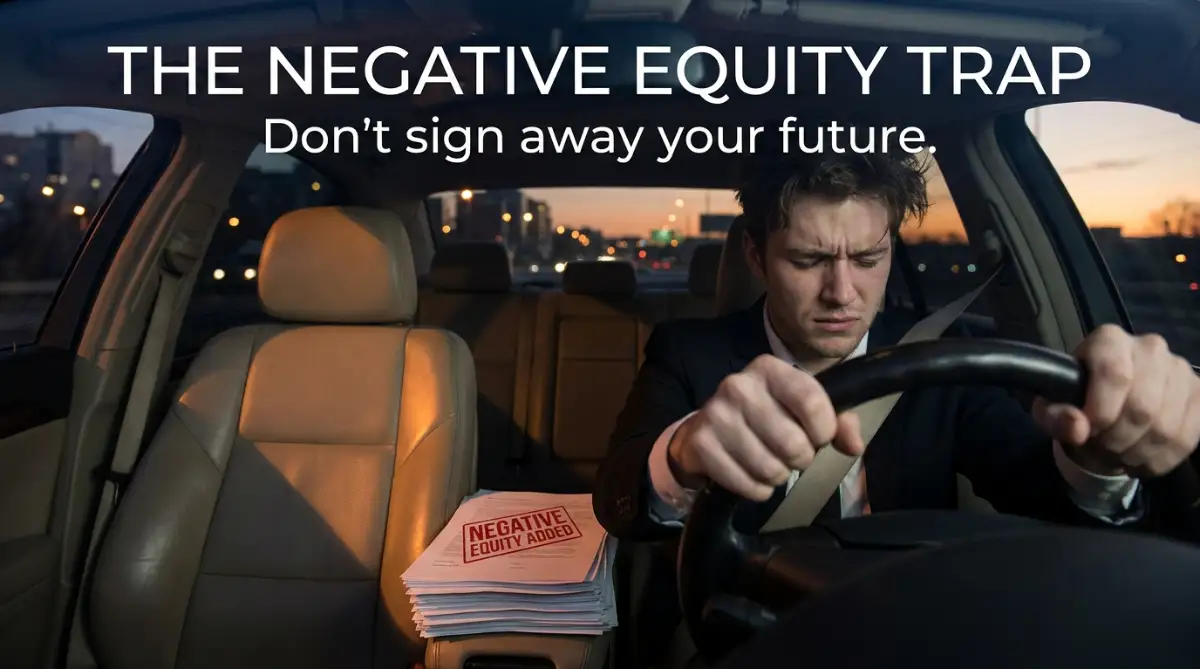
The Dealership Visit That Ruined My Budget
Walking into a car dealership with an old, rattling sedan usually ends in a massive financial trap. I learned this the hard way when a smooth-talking salesman convinced me to trade in my underwater car for a shiny new SUV. He promised my $6,000 of old debt would just magically disappear into the new loan. It sounded like a lifeline at the time, but I actually just signed up for years of suffocating monthly payments. Instead of getting a fresh start, I strapped a heavy anchor to my budget. Let me show you exactly how this dealership trick works so you never make the same expensive mistake I did.
He made it sound like a magic trick. I would get a shiny, reliable SUV, and my old car problem would just disappear. I signed the extremely thick stack of paperwork without really doing the math.
A few weeks later, my first loan statement arrived in the mail. I stared at the paper in absolute horror. I had purchased a $30,000 SUV, but my total loan balance was sitting at $38,000. I was paying nearly $800 a month. I had completely trapped myself in a financial cage, paying interest on a ghost car that I no longer even owned.
This is exactly how the negative equity trap works, and millions of hard-working people fall into it every single year. You walk into a dealership feeling stressed about your current car, and the finance manager uses confusing industry terms to make a terrible financial decision look like a huge favor.
They tell you that rolling over your debt is perfectly normal. What they do not tell you is that you are essentially taking out a massive personal loan at a high interest rate, just to get rid of your old car.
The worst part is the constant anxiety of knowing you owe significantly more than your car is actually worth. If you get into an accident and total the car tomorrow, your insurance will not cover the full amount you owe the bank. You would be left paying thousands of dollars out of your own pocket for a vehicle that is sitting in a junkyard.
You need to understand the brutal mathematics behind this dealership trick before you ever sign another piece of paper.

Quick Survival Guide: Dealing with Auto Debt
-
Understand the math: Rolling over negative equity means you are taking out a high-interest personal loan just to get rid of a car.
-
Beware of depreciation: Adding old debt to a brand new car guarantees you will be severely upside down the second you drive off the lot.
-
Protect yourself: If you are already stuck in this situation, call your insurance agent today and add Gap Insurance to protect against a total loss.
-
The ultimate fix: Keep driving your current car, ignore the squeaky belt, and throw all your extra cash at the principal balance until it hits zero.
Decoding the Dealership "Magic Trick"
To protect yourself, you first have to understand what negative equity actually means in the real world. In the car business, they often refer to this as being "upside down" or having a car that is "underwater."
It is a very simple concept: you owe the bank more money than your car is currently worth.
Let's look at a very common scenario. Imagine your current car loan has a payoff balance of $15,000. You take it to a dealership, and they appraise the car's actual market value at only $10,000.
That $5,000 difference is your negative equity. It is dead debt.
The Real Cost of Rollover Debt (A Quick Math Check)
To truly understand how bad this deal is, look at this simple breakdown. Here is what happens when you buy a $25,000 car with and without rolling over your old debt:
How the Rollover Actually Works
When you decide to buy a new car, the dealer tells you they will "take care of" your old loan. You feel relieved, thinking the problem is solved.
But the bank holding your old loan still wants their missing $5,000. The dealership does not pay this out of the kindness of their hearts.
Instead, they take the price of the new car you are buying—let's say it is $25,000—and they secretly stack that $5,000 of dead debt right on top of it.
Your new loan is now $30,000. You are now paying interest on your new car, plus you are still paying interest on the ghost of your old car.
The dealer did not help you. They simply reorganized your debt and attached it to a brand-new depreciating asset.

The Brutal Reality of Depreciation
The reason this strategy is so financially devastating is because cars lose value incredibly fast. As soon as you drive a brand-new car off the dealership lot, it loses roughly 20% of its value in the first year alone.
Let's go back to our example. You took out a $30,000 loan to buy a car that was originally priced at $25,000.
After one year of driving, that car is now only worth about $20,000 on the open market. But because you rolled over old debt and are paying mostly interest in the first year, your loan balance is probably still hovering around $28,000.
You are now underwater by $8,000 on your brand-new car.
You have created a massive snowball of debt that gets bigger and harder to escape every time you buy a vehicle. This cycle is exactly why people end up with $800 monthly payments on standard commuter cars.
Watch this excellent breakdown to see exactly how dealers hide these negative numbers in your monthly payment structure and how to spot their tricks.
The Hidden Dangers of Being Upside Down
Being upside down on a car loan is much more than just bad math on a piece of paper. It creates very real, dangerous risks for your everyday life and your long-term financial stability.
When you owe the bank more than your asset is worth, your financial flexibility completely disappears. You lose the ability to make choices.
The Total Loss Nightmare Scenario
Nobody ever plans on getting into a car accident. But if you hit a patch of ice and total your vehicle, your negative equity will instantly become a full-blown financial crisis.
Auto insurance companies do not care how much money you owe the bank. They are only legally obligated to pay you the actual cash value of the car on the exact day it was destroyed.
If your loan balance is $28,000, but the car is only worth $20,000, the insurance company will write a check for $20,000 directly to your lender.
Your lender will then immediately demand that you pay the remaining $8,000 out of your own pocket.
If you do not have eight thousand dollars sitting in a savings account, you will face aggressive collection calls, a ruined credit score, and you still will not have a car to drive to work.
My personal pro tip here is regarding Gap Insurance. If you are currently stuck in a loan with massive negative equity, you absolutely must call your insurance agent today and ask to add Gap Insurance. It is usually quite cheap, and it specifically covers that "gap" between what the car is worth and what you owe if it gets totaled. I have seen Gap Insurance save people from bankruptcy.
You Are Physically Trapped in the Car
Life changes rapidly. You might get pregnant and suddenly need a minivan, or you might lose your job and need to sell your expensive SUV to buy a cheap, older car for cash.
If you have negative equity, you are physically trapped in that specific vehicle. You cannot simply sell the car to a private buyer unless you have the cash on hand to pay off the negative balance first.
If you owe $20,000 and a private buyer offers you $15,000, the bank will refuse to release the car title to the new owner until you hand over the missing $5,000.
Most people living paycheck to paycheck do not have that kind of cash lying around. You are forced to keep making high monthly payments on a car you no longer want or can no longer afford, simply because you cannot afford to sell it.
Breaking the Cycle of Auto Debt
The absolute best way to handle negative equity is to aggressively pay it off while keeping your current car.
The Strategy of Staying Put
I know your old car might be boring. It might have a squeaky belt, a stain on the backseat, or lack the newest Apple CarPlay features. But keeping it is the absolute fastest way back to financial freedom.
Stop looking at new car commercials on television. Instead, take a hard, honest look at your monthly budget.
Cut out dining out, cancel unused subscription services, and throw every single extra dollar you have directly at your car loan principal.
Your ultimate goal is to get the loan balance down to zero, or at least down to the actual trade-in value of the car.
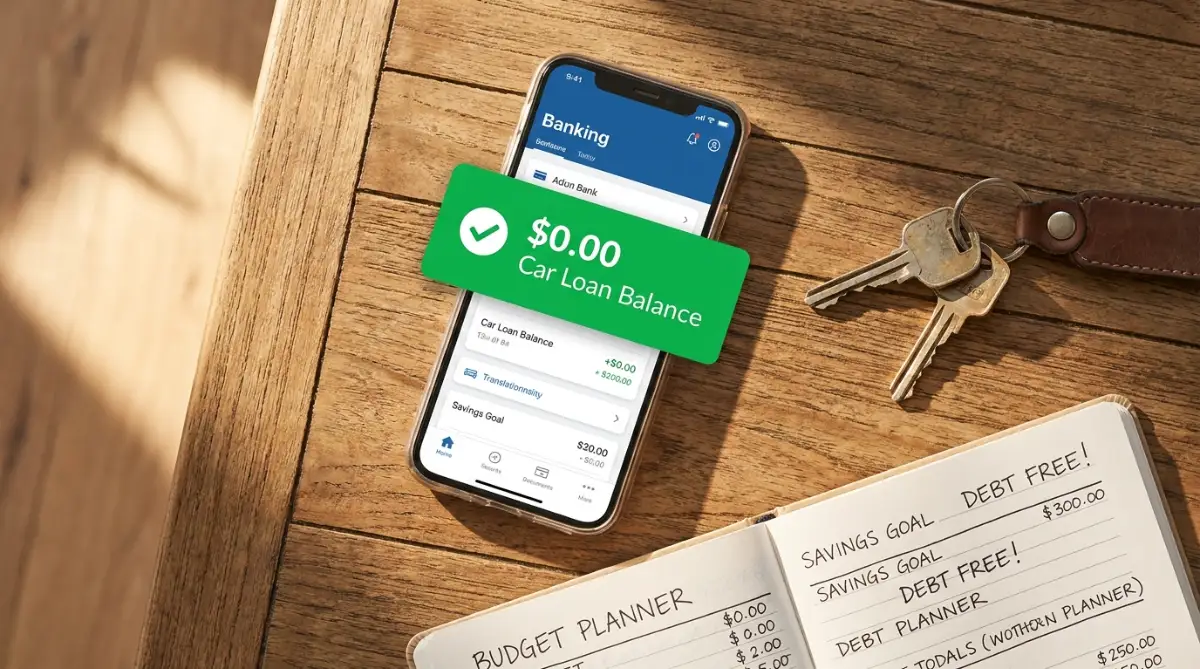
If your older car needs a $1,000 repair, just pay for the repair. Spending $1,000 to fix a car you already own is mathematically much smarter than rolling $5,000 of dead debt into a brand-new $30,000 loan.
Keep driving that old car until the wheels literally fall off. Every single month you drive a car without a car payment, you are putting hundreds of dollars back into your own pocket.
Myth vs. Reality: Keeping Your Old Car