
The Tears at the Kitchen Table: Why Homework Feels Like a Battle
Imagine it is Tuesday evening. You have just finished a long day of work, cooked dinner, and now you are sitting at the kitchen table with your four-year-old. You are simply trying to teach them the letters of the alphabet.
You point to the letter "A" on the flashcard. You ask them to repeat after you. Instead of looking at the card, your child is squirming in their chair, tapping their feet, and looking out the window.
You try again, your voice getting a little louder. Your child gets frustrated, pushes the cards away, and starts crying. Suddenly, you feel a heavy weight in your chest.
You wonder, "Why is this so hard? Am I doing something wrong? Is my child falling behind the other kids in preschool?" This exact scenario plays out in millions of homes every single night.
The mental exhaustion of trying to teach a child who simply will not focus is overwhelming. It drains your energy and makes you question your own parenting skills. You just want your child to succeed, but every learning session ends in tears and frustration for both of you.
Here is a comforting truth you need to hear right now: You are not a bad parent, and your child is not broken. The problem is not their intelligence or your teaching ability.
The real issue is a simple miscommunication. You are speaking one learning language, and your child’s brain is wired to understand a completely different one. Until you figure out how their specific brain absorbs information, you will constantly feel like you are pushing a heavy boulder up a steep hill.
Today, we are going to change that entirely. We are going to explore exactly how your child's brain works so you can turn those stressful evenings into moments of joy and easy connection.
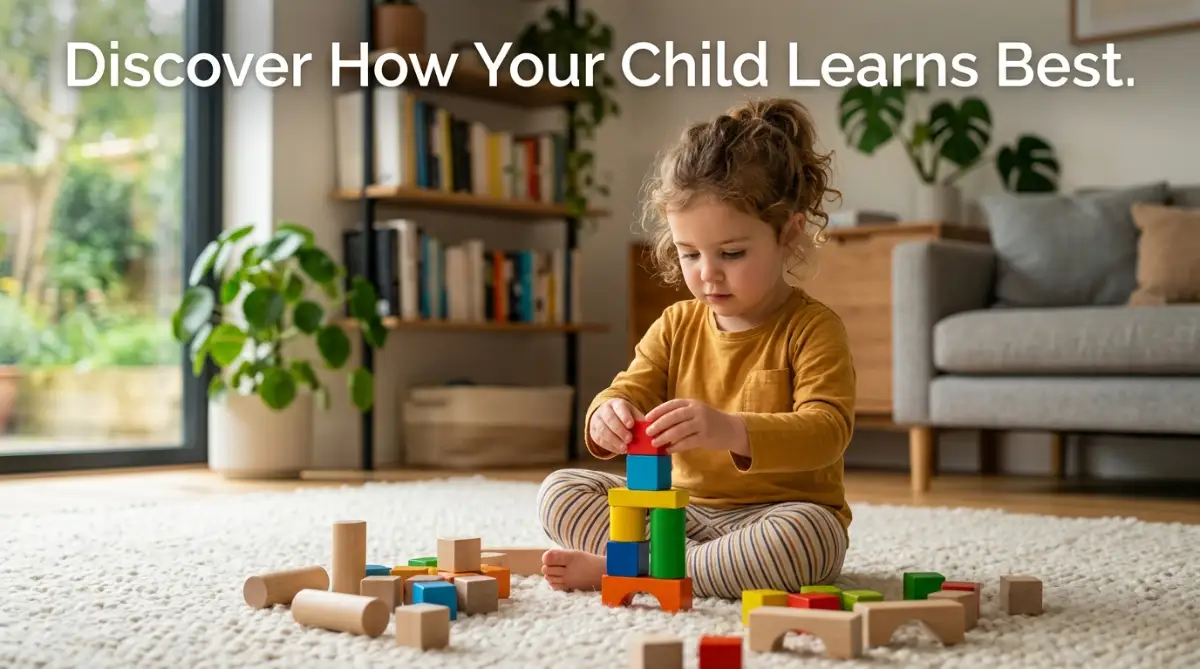
The Secret Code to Your Child's Brain
To fix this daily struggle, we need to completely rethink what "learning" actually looks like. Many of us grew up in traditional classrooms. We were told to sit still, fold our hands, look at the chalkboard, and listen to the teacher.
Because we were raised this way, we naturally assume this is the only way to teach our own children. But modern psychology proves this is completely false. Every human brain processes new information through different sensory pathways.
Some children need to see things in bright colors. Some need to hear a rhythm. Others absolutely must move their bodies to understand a new concept.
When you try to force a child who needs physical movement to sit perfectly still and look at a book, their brain literally shuts down. It is like trying to feed a newborn baby with a fork instead of a spoon. The intention is good, but the method is completely wrong.
Psychologists use a popular system called the VARK model to explain this. VARK stands for Visual, Auditory, Reading/Writing, and Kinesthetic. Let us break down exactly what these mean in plain English, and how you can spot these traits in your own living room.
The Visual Learner: Seeing the World in High Definition
Visual learners absorb information best through their eyes. Their brains are like little cameras, constantly taking snapshots of the world around them.
If your child is a visual learner, you might notice they are naturally drawn to bright colors and illustrated books. They often notice tiny details that you completely miss, like a small bug on the sidewalk or a new picture frame on the wall.
These children love to draw, paint, and watch demonstrations. When you explain something to them using only your words, they might look at you with a blank stare. They need to see it to believe it.
How to spot a visual learner at home:
- They prefer looking at the pictures in a book rather than listening to the story.
- They love matching games and color-sorting activities.
- They often say things like, "Show me how to do it."
Practical tips for teaching a visual learner:
If you want to teach them the alphabet, do not just sing the ABC song. Buy brightly colored alphabet blocks. Use a whiteboard with different colored markers.
When giving them chores, do not just tell them to clean their room. Draw a simple picture chart showing a toy box, a made bed, and clean clothes. Visual cues instantly make sense to their active brains.
The Auditory Learner: Absorbing Knowledge Through Sound
Auditory learners are the listeners and the talkers. Their ears are their primary tools for gathering information.
These children are often very early talkers. They love to hum, sing, and make up random songs about their day. You might notice that they easily memorize the lyrics to commercials or theme songs after hearing them just once.
However, because their ears are so sensitive, they are easily distracted by background noise. If the television is on in the next room, an auditory learner will have a very hard time focusing on the puzzle in front of them.
How to spot an auditory learner at home:
- They constantly talk to themselves while playing alone.
- They ask a million questions and love long explanations.
- They close their eyes when trying to remember something.
Practical tips for teaching an auditory learner:
Turn learning into a musical experience. If you are teaching them how to spell their name, make up a catchy little rhythm or a rhyming song.
When you read a book together, use different, funny voices for every single character. Ask them to read the story back to you out loud. Hearing their own voice actually helps cement the information in their memory.
The Kinesthetic Learner: Bodies in Constant Motion
This is the learning style that confuses and frustrates parents the most. Kinesthetic learners learn through touch, movement, and physical interaction.
These are the children who simply cannot sit still. They touch the walls when they walk down the hallway. They take their toys apart just to see how they work.
In a traditional school setting, these children are often wrongly labeled as "troublemakers" or diagnosed with attention issues. But the reality is, their brain requires muscle memory to process new ideas.
If you tell a kinesthetic learner to sit on their hands and listen, you have just blocked their primary pathway for learning.
How to spot a kinesthetic learner at home:
- They talk with their hands and use big gestures.
- They excel in sports, dancing, or climbing.
- They lose interest quickly if they cannot physically touch what you are showing them.
Practical tips for teaching a kinesthetic learner:
You must involve their bodies in the lesson. If you want to teach them basic math, do not use a worksheet. Go to the kitchen and ask them to physically count out five apples and put them in a bowl.
If you are teaching them letters, have them trace the letter "B" in a tray filled with sand or shaving cream. Let them stand up, jump, or pace around the room while reciting facts. Movement is their superpower, not a weakness.
The Reading and Writing Learner: Drawn to the Written Word
While this style is a bit rare in very young toddlers, it becomes obvious as they reach preschool and kindergarten age. These children prefer text-based input and output.
They are fascinated by lists, diaries, and written instructions. Even before they can fully read, they might pretend to write long letters or carry around a small notebook.
They prefer quiet environments where they can focus on words. For them, the structure of written language feels incredibly safe and organized.
How to spot a reading/writing learner at home:
- They love looking at signs, menus, and labels at the grocery store.
- They enjoy tracing letters and spelling words out on paper.
- They prefer reading a book over watching a video about the same topic.
Practical tips for teaching a reading/writing learner:
Encourage them to make lists with you. Before going to the store, ask them to help you write down the groceries.
Use sticky notes to label items around their bedroom, like "Bed," "Door," and "Window." Seeing the physical word attached to the object helps their brain make instant connections.
Myth vs Reality: Breaking Common Parenting Beliefs
Before we move further, we need to clear up some major misconceptions about how children develop. So much bad advice is passed down from generation to generation.
The Myth: "If my child is a kinesthetic learner, they will never be able to sit down and read a book."
The Reality: Learning styles are not strict rules. They are simply preferences. A kinesthetic learner can absolutely love reading, provided they are allowed to wiggle, change positions, or hold a squishy toy while they read.
The Myth: "I need to find out my child's one exact learning style and only teach them that way."
The Reality: Almost all children are mixed learners. They might be 60% visual and 40% auditory. The goal is not to put your child in a rigid box. The goal is to observe what works best in moments of high frustration and lean into that specific method.
How Different Learners React to the Same Lesson
To make this completely clear, let us look at a real-life scenario. Imagine you want to teach your child about a "Dog." Here is how different brains will process that same lesson.
Learning Style: How They Best Understand the Concept of a "Dog"
Visual Learner: Needs to look at photos of different dog breeds and watch videos of dogs playing.
Auditory Learner: Wants you to explain what a dog sounds like (barking) and hear stories about dogs.
Kinesthetic Learner: Needs to physically pet a real dog or play on the floor acting like a dog.
Reading/Writing: Enjoys looking at the letters D-O-G written on a chalkboard or reading a basic textbook about pets.
By simply observing your child during playtime, you can easily figure out which column they fit into naturally. Once you have this secret code, you can unlock their full potential without the daily arguments and tears.
Mastering the Mix: Long-Term Strategies for Everyday Success
Now that you know how to identify your child's unique learning language, the real magic begins. You do not need to buy expensive tutoring programs or turn your living room into a strict schoolhouse.
Long-term success comes from making tiny, invisible adjustments to your daily routine. We want your child to learn naturally while they play, eat, and interact with the family. This approach removes the heavy pressure and turns education into a fun, daily habit.
Think about how a smart financial planner manages risk for the future. When they learn how to design a balanced crypto portfolio from scratch, they never put all their money into one single asset. They diversify to keep things safe and growing.
Parenting works in the same way. You should never rely on just one teaching method. Even if your child is heavily visual, you still want to sprinkle in auditory and physical activities to keep their brain sharp and adaptable.
The Power of "Sneaky" Education
The best way to teach a child is when they do not even realize they are being taught. We call this "sneaky education," and it works wonders for all learning styles.
If you have a kinesthetic learner, do not ask them to sit and do math homework. Instead, ask them to help you bake cookies. Have them physically measure out two cups of flour and one cup of sugar.
While they are pouring and mixing, their brain is actively processing fractions and measurements. They are building strong neural pathways through physical touch and movement.
If your child is an auditory learner, turn grocery shopping into a memory game. Ask them to remember three specific items you need from the produce aisle. When you get there, let them verbally guide you to the apples, bananas, and carrots.
According to research from the National Association for the Education of Young Children (NAEYC) regarding play-based learning, children develop much deeper cognitive skills when education is disguised as natural, child-led play. When you remove the pressure of a "test," their natural curiosity instantly takes over.
Real-Life Scenario: The Morning Routine Fix
Let us look at a practical example that happens in every home: getting dressed for school. For many families, mornings are filled with yelling, rushing, and crying.
If your child is a visual learner, telling them "Go put your shoes on" from the kitchen will not work. They will walk into their room, see a toy, and completely forget your instructions.
The pro-level fix is to change the environment. Create a visual checklist and tape it to their bedroom door. Draw a picture of a shirt, pants, socks, and shoes.
When they wake up, they can look at the chart and know exactly what to do without you saying a single word. This builds their independence and completely stops the morning arguments.
Expert Q&A: Navigating Changing Habits
Question: What if my child seems to change their learning style from day to day?
Answer: This is completely normal! Children’s brains are highly elastic. A child might prefer visual learning when they are highly energetic, but switch to auditory learning (like listening to an audiobook) when they are tired and winding down for the night.
Question: How long should a learning session last at home?
Answer: Keep it incredibly short. A four-year-old only has a natural attention span of about ten to fifteen minutes. Pushing them to study for an hour will only cause a massive meltdown and make them hate the subject.
Question: Can physical distractions change how they learn?
Answer: Absolutely. Physical comfort is the absolute foundation of mental focus. If your child is wearing an itchy sweater or suffering from a rash due to the hidden dangers of expired cosmetics on sensitive skin like cheap face paint, they cannot focus. Always make sure their physical needs are met before trying to teach a new concept.
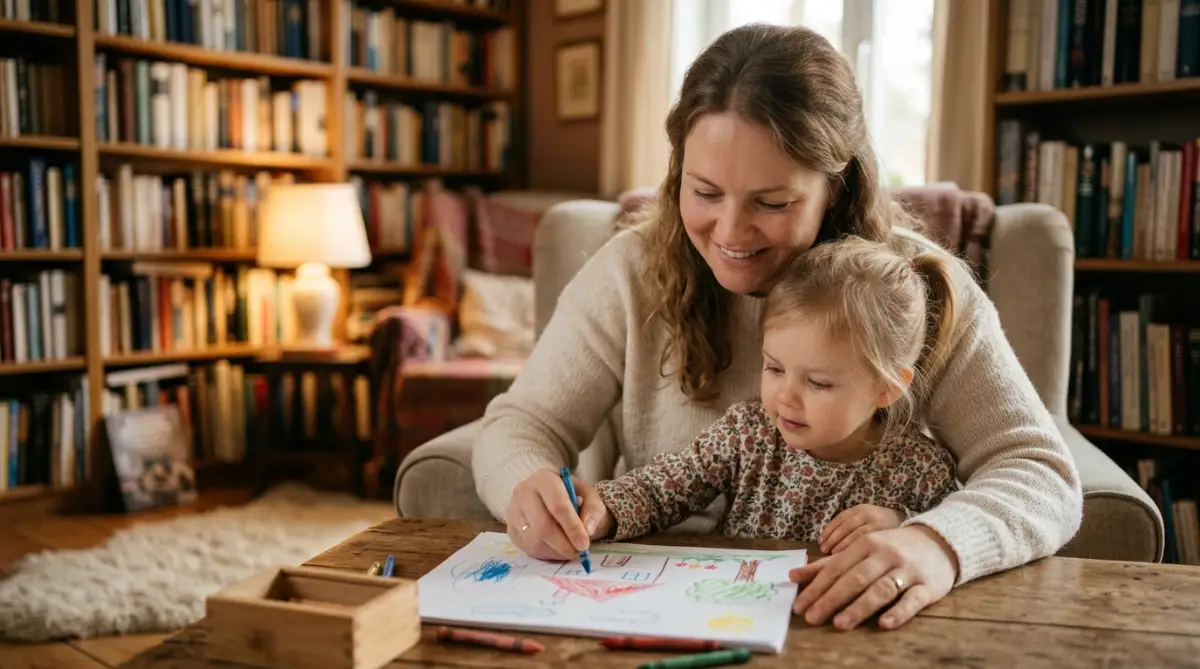
The Hidden Traps That Sabotage Your Child's Confidence
Even with the best intentions, parents easily fall into frustrating habits. We often revert to how we were parented, especially when we are tired or stressed.
However, making these common mistakes does not just delay learning. It can actively damage your child's self-esteem and make them believe they are not smart enough.
We need to identify these emotional traps so you can stop them before they cause lasting harm. Awareness is your best defense against parental burnout.
The Danger of the "Sit Still and Listen" Demand
This is the most frequent and damaging mistake parents make, particularly with highly active children. When your child is bouncing off the walls, your natural instinct is to demand they sit perfectly still at the table.
You think that stillness equals focus. But for a kinesthetic learner, stillness actually equals mental shutdown.
When you force an active child to stop moving, they have to use 100% of their brainpower just to control their body. They have no mental energy left to actually listen to what you are trying to teach them.
If you punish them for wiggling, they start to associate learning with feelings of shame and physical restriction. Let them stand. Let them bounce on a yoga ball. Let them pace the room while reciting their spelling words.
The Toxic Trap of Sibling Comparison
Every child's brain develops on a completely different timeline. It is incredibly easy to look at your oldest child, who learned to read quietly at age four, and compare them to your youngest child, who is five and still hates books.
Saying things like, "Why can't you focus like your sister?" is a massive blow to a child's confidence. They do not hear encouragement to do better. They hear, "You are broken, and your sister is better than you."
The experts at the Child Mind Institute clearly warn about sibling comparison, noting that it builds deep resentment and severe anxiety. Your child will simply stop trying because they feel they can never win the competition.
Celebrate your child's unique method. If they build an incredible fort out of sofa cushions to understand geometry, praise their engineering skills instead of scolding them for making a mess.
Over-Teaching After a Long Day
We often forget how exhausting the world is for a young brain. They spend their entire day at preschool or daycare navigating loud noises, new rules, and social conflicts.
When you bring them home and immediately demand they practice flashcards, you are setting everyone up for a massive emotional explosion. Their mental tank is empty.
Do not force education on a tired brain. Give them an hour of pure, unstructured free time when they get home. Let their nervous system reset.
A Quick Do's and Don'ts Checklist
- Do: Pay attention to what they choose to do during free time. Their natural play shows you exactly how they prefer to learn.
- Don't: Force a teaching method that always ends in tears. If it makes them cry every time, the method is wrong, not the child.
- Do: Use big, exaggerated emotions and funny voices if they are an auditory learner. It instantly grabs their attention.
- Don't: Buy expensive educational toys thinking they will fix a learning gap. Your active participation and understanding are worth more than any plastic toy.
Your New Action Plan for Tomorrow Morning
We have covered a lot of ground today. You now hold the secret blueprint to understanding exactly how your child’s brain processes the world around them.
You no longer have to guess why they are ignoring your instructions or crying over a simple math problem. You have the tools to adapt, pivot, and connect with them on a level they actually understand.
Tomorrow is a brand new day, and it is your chance to start fresh.
When you wake up, take five minutes to simply watch your child play before you give them any instructions. Notice if they are looking at the pictures in a book, talking to their stuffed animals, or physically taking a toy apart.
Once you spot their natural preference, lean into it completely. Speak their language.
If they want to move, let them move. If they need visual charts, grab a box of crayons and draw those charts together.
You are going to see a massive shift in their behavior. The daily battles will fade away, replaced by genuine moments of curiosity and laughter. You are an amazing parent for taking the time to learn this, and your child is incredibly lucky to have you guiding them.