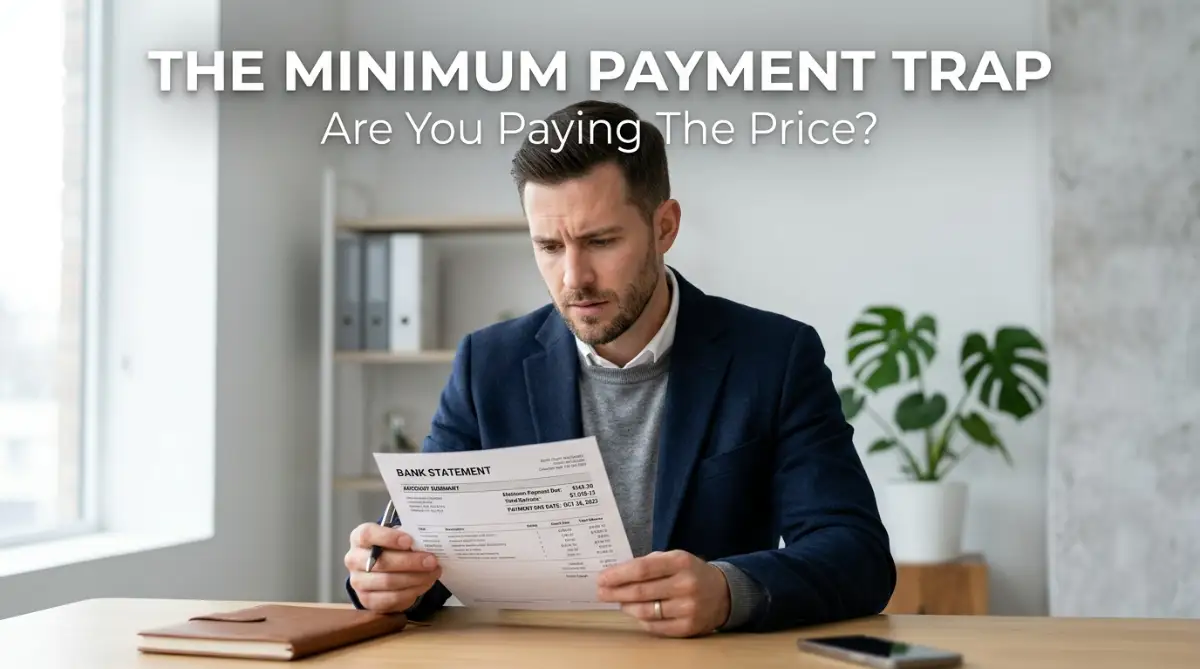
The Temporary Relief That Quietly Destroys Your Wealth
You open your email or check your mail and see the monthly credit card statement waiting for you. Your heart beats a little faster. You know you spent more than usual on groceries, car repairs, and maybe a small weekend trip. You scroll down to the total balance and see a terrifying number. You owe $4,500. A wave of anxiety washes over you as you wonder how you will ever pay that off before the next paycheck arrives. But then, your eyes move to a much smaller, friendlier number just below it. "Minimum Payment Due: $45." Suddenly, a massive wave of relief hits you.
You think to yourself, "I can easily afford $45 right now. I will just pay this small amount today and worry about the rest of the big balance next month." You click the payment button, feel instantly productive, and go to sleep with a peaceful mind. This is exactly how the trap snaps shut. This false sense of financial safety is exactly what credit card companies want you to feel. They are not doing you a favor by offering a low payment option.
In reality, paying that small amount is the financial equivalent of putting a tiny bandage on a deep, bleeding wound. You are not solving the problem at all. You are actually buying a ticket to a never-ending cycle of financial stress.
Every single time you choose that minimum option, you are quietly handing over your future wealth to massive financial institutions. The peace of mind you feel tonight is actually costing you thousands of hard-earned dollars in the long run. Let us break down the exact math and psychology behind this dangerous financial illusion.
The Teaspoon Analogy: Why Your Debt Never Shrinks
To truly understand this problem, you need to picture a large swimming pool. Imagine that this swimming pool is filled to the top with water. This water represents your total credit card debt.
Now, imagine trying to empty that massive swimming pool using only a tiny plastic teaspoon. That teaspoon represents your minimum payment. Every month, you scoop out one tiny spoonful of water and throw it on the grass. It feels like you are doing something productive. You are technically removing water from the pool. However, there is a serious catch that you cannot see. While you are using that teaspoon, the credit card company has a garden hose actively pumping new water right back into your pool. This hose represents compound interest.
Because the hose is pumping water in much faster than your teaspoon can remove it, the water level barely drops. In many cases, the water level actually rises higher than when you started. This is exactly why you can make on-time payments for a full year and suddenly realize your total balance has not changed at all. The interest is simply eating your payments alive.
The Mathematics of Bank Profits
Credit card companies are not charities. They are highly profitable businesses designed to make money off your borrowed funds. When they set your minimum payment, they usually calculate it as a tiny percentage of your total balance. In most cases, it is just 1% or 2% of the principal amount, plus whatever interest is gathered that month.
They set this number intentionally low. If they asked you to pay $500 a month, you would panic, cut up the card, and never use it again. By keeping the minimum requirement low, they keep you comfortable enough to stay in debt. If you are comfortable, you will keep the account open. As long as the account stays open and carries a balance, they get to charge you interest every single day.
The Real-Life $5,000 Scenario
Let us step away from analogies and look at a very real, mathematical example. Suppose you currently have a $5,000 balance on your favorite rewards credit card. The Annual Percentage Rate (APR) on this card is 20%. This is a very standard interest rate for most unsecured consumer credit cards today.
The bank requires a minimum payment of either $25 or 2% of the balance, whichever is higher. For a $5,000 balance, your minimum payment would be around $100. You decide to stop using the card entirely and commit to paying exactly $100 every single month. You might think this will clear the debt in about four years. The actual truth is completely shocking.
If you only pay that $100 minimum, it will take you over 108 months to pay off the debt. That is exactly 9 years of your life tied to a single $5,000 purchase. But it gets much worse when you look at the interest paid. Over those 9 years, you will hand the bank over $5,800 just in interest charges alone. You will end up paying a total of $10,800 for something that originally cost $5,000.
Understanding Daily Average Balance
One of the biggest secrets in the banking industry is how interest is actually calculated. Many people assume interest is charged once at the end of the month. This is entirely incorrect. Credit card interest is calculated based on your average daily balance.
Every single day that you carry a balance, the bank takes a tiny slice of your APR and applies it to your debt. Yesterday's interest is added to today's total balance. Then, tomorrow's interest is charged on top of today's new, higher balance. This compounding effect means your debt is growing while you are sleeping, while you are working, and while you are on vacation. It never stops.
When you only pay the minimum, a massive portion of your payment goes directly toward paying off the interest that built up over the last 30 days. Only a few dollars actually touch the principal amount you originally borrowed.
The Psychological Anchor of the Statement
We have to talk about why intelligent people fall for this trap. It is heavily tied to human psychology and a concept called "anchoring."
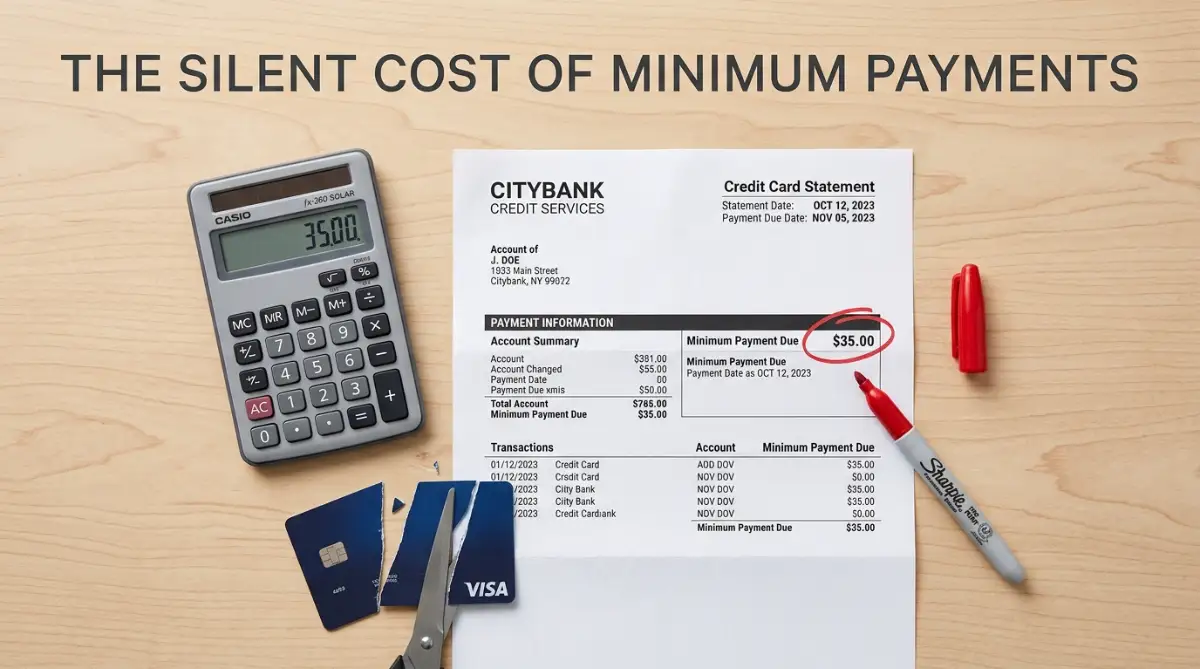
When you look at a piece of paper, your brain naturally looks for instructions. The credit card statement places a heavy visual emphasis on the minimum payment box. It is often bolded, highlighted, or placed inside a brightly colored square. By heavily promoting this number, the bank sets an anchor in your mind. Your brain subconsciously accepts this low number as the "recommended" or "correct" amount to pay.
Even if you have an extra $300 sitting in your checking account, your brain will often convince you to just pay the $45 minimum. You feel like you followed the rules and completed the task.
The bank successfully anchored your behavior to their most profitable outcome. Breaking this psychological anchor is the first major step toward gaining real financial independence.
Myth vs Reality: The Credit Score Confusion
There is a lot of bad advice floating around on social media regarding credit cards. Let us clear up a massive misunderstanding right now.
The Myth: "As long as I make the minimum payment on time, my credit score is perfectly safe."
The Reality: Making the minimum payment does protect you from late fees, and it keeps your account in "good standing." However, it absolutely does not protect your overall credit score. In fact, carrying a high balance from month to month will severely damage your score over time.
This happens because of something called the Credit Utilization Ratio. This ratio makes up about 30% of your total credit score calculation. Your utilization ratio is simply the amount of debt you have compared to the total credit limit the bank gave you. For example, if you have a $10,000 limit and you owe $8,000, your utilization is at 80%.
Credit bureaus want to see this ratio kept below 30%. When you only pay the minimum, your balance stays high, which keeps your utilization dangerously high.
When other lenders see a high utilization ratio, they view you as a massive financial risk. They assume you are struggling to make ends meet and rely heavily on borrowed money to survive. This makes it incredibly difficult to get approved for a car loan, an apartment lease, or a future mortgage.
The Hidden Warning Label You Ignore
If you look closely at your physical or digital statement, you will notice a small box usually titled "Minimum Payment Warning." This is not placed there because the bank wants to help you. They are legally required by consumer protection laws to include this box on every statement. It clearly outlines exactly how long it will take to pay off your current balance if you make no further purchases and only pay the minimum.
Next time you get your bill, do not throw the paper away. Force yourself to read that specific box. Seeing the words "It will take 14 years to pay off this balance" printed in black and white is often the emotional shock people need. It removes the comforting illusion and forces you to confront the mathematical reality of your situation.
What Happens When Emergencies Strike
Another hidden danger of this habit is the loss of your financial safety net. Life is incredibly unpredictable. Cars break down, medical emergencies happen, and roofs suddenly leak. If you have been paying only the minimum, your credit cards are likely pushed close to their maximum limits. When a real emergency happens, you will reach for your card only to find that it gets declined. Because you never paid down the principal, you have zero available credit left to handle a crisis.
This forces people into terrible situations, like taking out predatory payday loans or borrowing money from family members under stressful conditions. Managing your debt aggressively is not just about saving on interest. It is about keeping your available credit open for actual, unexpected life events.
Strategic Methods to Break the Debt Chain Forever
Now that you understand exactly how the banks keep you trapped, it is time to fight back. You do not have to accept a lifetime of monthly payments and financial stress. Breaking free from this cycle requires a shift in how you view your money. You have to stop looking at the minimum payment box entirely. Instead, you need a proactive strategy that attacks the principal balance directly.
Think of your debt as a financial emergency. You would not put a small band-aid on a broken arm, and you should not put a $45 payment on a growing $5,000 problem. Let us look at the most powerful, proven methods to permanently destroy your credit card debt.
Establish a Fixed "Power Payment"
The easiest way to beat the bank is to create your own minimum payment rules. Look at your monthly budget and find out exactly how much extra cash you can spare. If your bank asks for $45, but you know you can safely afford $150, make $150 your new permanent minimum. Do not let the bank dictate what you should pay.
Set up an automatic transfer from your checking account for this new amount. By doing this, you remove the emotional temptation to pay less. You are effectively locking in your success before you even have a chance to spend that money on something else.
The Phone Script That Saves Thousands
Most people have no idea that they can simply negotiate their interest rates. Credit card companies spend millions of dollars trying to acquire new customers. They would much rather lower your rate than lose you to a competitor. Call the customer service number on the back of your card. When you get a representative on the line, use this exact script:
"Hello, I have been a loyal customer for several years, but my current interest rate of 24% is simply too high. I have received offers from other banks for a 0% balance transfer. Can you lower my current APR so I can keep my account with you?"
If they say no, ask to speak to the retention department. Often, a simple ten-minute phone call can drop your rate by 5% or more. This means hundreds of dollars will suddenly go toward your actual debt instead of bank profits.
Expert Q&A: Choosing Your Attack Plan
Question: Should I pay off the card with the highest interest first, or the one with the smallest balance?
Answer: This is a classic debate in personal finance. Paying the highest interest card first is called the Avalanche Method. It saves you the most money mathematically. However, if you need quick psychological wins to stay motivated, use the Snowball Method. This means attacking the smallest balance first to clear it out completely.
Question: Do I need a complicated spreadsheet to track all of this?
Answer: Not at all. Keeping things simple is often the best approach. Much like learning how to design a balanced crypto portfolio from scratch, the key is to build a basic system you actually understand. A simple notebook showing your starting balance and monthly payments is all you really need.
Question: Is it safe to use a debt settlement company?
Answer: You must be extremely careful here. Many third-party companies charge massive upfront fees and tell you to stop paying your bills entirely, which destroys your credit score. You can read the federal warnings regarding debt settlement companies directly from the FTC to understand exactly how these scams operate. It is almost always better to handle negotiations yourself.

The Emotional Financial Traps That Keep You Broke
Even when people decide to finally attack their debt, they often stumble into hidden traps along the way. The financial industry is full of clever marketing designed to keep you borrowing.
When you leave toxic habits unchecked, the results are always painful. Ignoring your daily interest charges is a lot like ignoring the hidden dangers of expired cosmetics on sensitive skin. The damage happens quietly behind the scenes, and by the time you see the physical reaction, repairing it takes massive effort. To protect your wealth, you must recognize these common mistakes before they derail your progress. Avoid these massive pitfalls at all costs.
The Balance Transfer Illusion
Balance transfer cards sound like a dream come true. The bank offers you 0% interest for 18 months if you move your debt over to them. While this can be a smart tool, it ruins most people. Why? Because they transfer a $5,000 balance to a new card, and suddenly their old credit card has a zero balance.
Instead of cutting up the old card, they feel a false sense of wealth. They start using the old card again for groceries and dinners. Fast forward six months, and they now have a $5,000 balance on the new card, plus a fresh $3,000 balance on the old card. They just doubled their debt without even realizing it. If you use a balance transfer, you must physically lock away your old cards so you cannot use them.
Closing the Account Out of Spite
Let us say you finally pay off that terrible, high-interest credit card. You are so angry at the bank for charging you all those fees that you immediately call them and cancel the card. You think you are teaching them a lesson, but you are actually shooting your own credit score in the foot. Closing an old credit account is one of the worst things you can do for your financial profile.
Your credit score relies heavily on your total available credit and the average age of your accounts. When you close your oldest card, you instantly wipe out years of positive payment history. You also lower your total available credit limit, which causes your credit utilization ratio to spike overnight. A higher ratio makes your credit score drop heavily.
The smart move: Pay the card off completely, cut the physical plastic card in half, and delete the number from your phone. Leave the account open with a zero balance. This keeps your credit score high while eliminating the temptation to spend.
Treating Credit Limits as an Emergency Fund
Many people refuse to build a cash savings account because they rely on their credit cards for emergencies. They think, "If my car engine breaks, I will just put it on my Visa." This mindset guarantees that you will never escape the minimum payment cycle. When you use a high-interest card for a sudden $1,500 emergency, you instantly create a brand new monthly bill.
If you truly want to verify how these balances impact your overall financial picture, you can review the official rules on how credit card interest is calculated provided by the Consumer Financial Protection Bureau. It clearly shows how carrying emergency debt turns a temporary crisis into a permanent financial burden. Before you aggressively pay down your debt, you must save a beginner emergency fund of at least $1,000 in cash. This acts as a protective shield. When the car breaks down, you use your cash instead of reaching for the plastic.
A Quick Do's and Don'ts Checklist for Debt Payoff
- Do: Check your statement every single month. Look specifically at how much of your payment went to interest versus the actual principal.
- Don't: Rely on the auto-pay feature if it is only set to the minimum amount. Update your auto-pay settings immediately to reflect your new "Power Payment."
- Do: Celebrate small milestones. If you pay off $500, take a moment to feel proud of yourself. Positive reinforcement keeps you focused on the long game.
- Don't: Hide your financial struggles from your partner or spouse. Financial secrecy destroys relationships faster than almost anything else. Sit down together and build a joint attack plan.
Your 48-Hour Debt Attack Plan
Reading about personal finance is great, but knowledge without action is entirely useless. You now know exactly how the banks manipulate the minimum payment system to keep you trapped.
You also know that educating yourself on money management is a lifelong journey. Just as families rely on a parent's guide to understanding early childhood learning styles to adapt to new challenges, you must adapt to new financial habits to protect your future.
You have the power to stop this bleeding right now.
I want you to take three specific actions within the next 48 hours. First, log into your banking app and look at your current balance. Find that warning box that tells you how long it will take to pay off the card by making minimum payments. Let that number make you slightly uncomfortable. Use that discomfort as fuel. Second, look at your checking account and decide on a new, fixed payment amount. Even if it is just $20 more than the minimum, lock that number into your auto-pay settings. Third, pick up the phone tomorrow morning and call the number on the back of your card. Use the negotiation script we talked about to demand a lower interest rate.
Every dollar you save on interest is a dollar that stays in your pocket. You work far too hard for your money to hand it over to massive banks every single month. Take control of your statements today, and start building the wealthy, stress-free life you actually deserve.
Financial & Legal Disclaimer:
The information provided in this article is for educational and informational purposes only and does not constitute professional financial, legal, or tax advice. Personal finance is highly subjective, and your individual situation may vary. We are not certified financial planners or advisors. Before making any major financial decisions, such as aggressively paying down debt, altering your credit profile, or engaging with creditors, please consult with a licensed financial professional or credit counselor to ensure it aligns with your specific financial goals.