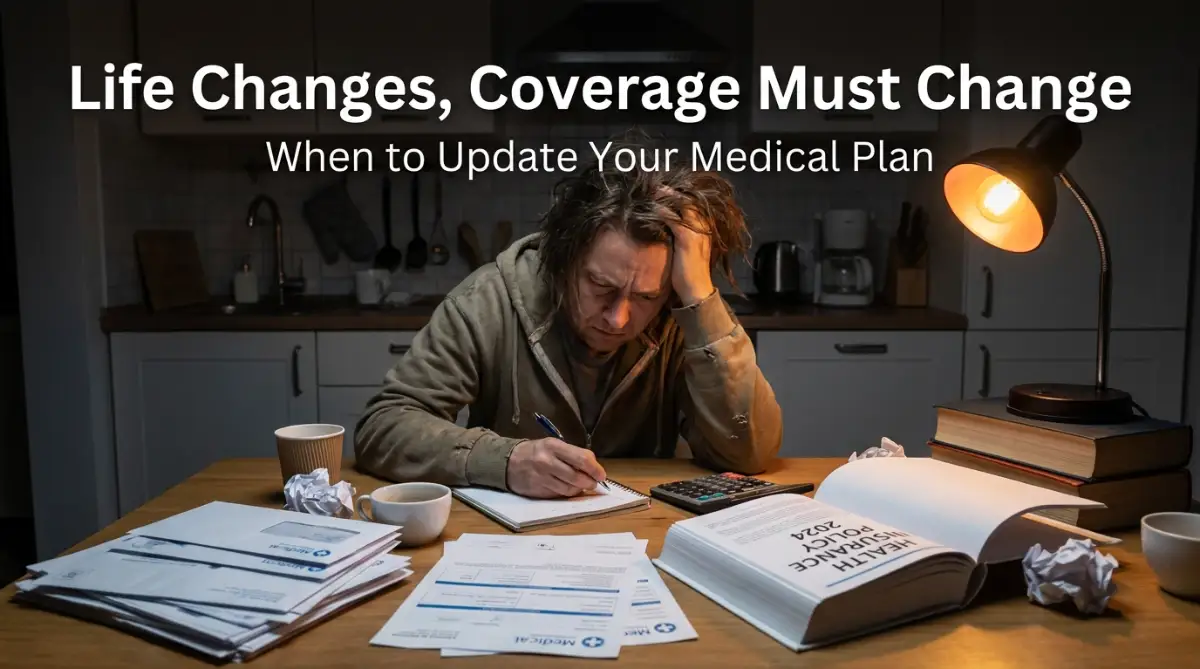
The Day My Health Plan Completely Failed Me
I was sitting in the cold, sterile waiting room of the emergency department, holding my husband's hand while my heart hammered in my chest. We had just rushed in because of a sudden, terrifying pain in my stomach, and all I could think about was getting better. When the billing coordinator finally pulled me aside hours later, I handed her my insurance card with total confidence. She typed on her keyboard, gave me a deeply sympathetic look, and quietly explained that my current plan only covered a tiny fraction of this specific hospital visit. Because we had recently gotten married and I forgot to combine our benefits properly, I was suddenly staring at a medical bill that completely wiped out our honeymoon savings. I felt entirely foolish, angry, and financially exposed at the exact moment I needed to feel safe.
That raw feeling of financial panic is something thousands of normal people experience every single day. We buy health insurance hoping it will act as an unbreakable shield when life throws a curveball at us.
We sign up for a plan through our employer, set it on auto-pay, and completely forget about it for years. We assume that the coverage that protected us as single, healthy twenty-somethings will magically keep protecting us as our lives become more complicated.
This dangerous assumption silently destroys the mental peace of hard-working families everywhere. When a sudden illness hits, the last thing you should be worrying about is whether your policy actually covers the treatment you desperately need.
You should be focusing entirely on healing, not secretly calculating how many weeks of groceries you will have to skip to pay the hospital. The constant, nagging fear of unexpected medical debt ruins your ability to fully enjoy the big moments in your life.
People genuinely believe that reviewing their medical coverage is a boring, confusing task best left for human resources departments. They avoid looking at the complicated paperwork because the medical jargon makes them feel unintelligent and deeply frustrated.
But hiding from the paperwork is the absolute fastest way to invite a financial disaster into your living room. We have to stop treating our health policies like forgotten gym memberships and start treating them like living, breathing documents that must grow exactly as we do.

The Shocking Moments Your Plan Becomes Obsolete
You do not need to become an insurance expert to protect your wallet. You simply need to recognize the exact moments when your current safety net is no longer strong enough to hold you. Insurance companies rely entirely on your forgetfulness to maintain their massive profit margins.
By taking control during specific life transitions, you force the system to actually work in your favor. Let us break down the exact, real-world situations where keeping your old policy is the most expensive mistake you can possibly make.
The Marriage Penalty Nobody Talks About
Getting married is easily one of the most exciting, joyful experiences you will ever have. Between picking out flowers and planning the perfect reception, reviewing your medical benefits usually falls to the absolute bottom of the priority list.
Most newlyweds simply keep their separate, individual employer plans because it seems like the easiest option. This is a massive mathematical error.
When you get married, the government and insurance providers instantly grant you a Special Enrollment Period. This is a tiny, magical window of time where you are legally allowed to completely change your coverage outside of the normal yearly schedule.
If your partner has an incredible corporate plan with a tiny deductible, and you have a terrible, expensive plan, keeping them separate is literally burning money. You must sit down together, pull up both summary documents, and ruthlessly compare the numbers.
Often, moving both spouses onto the single best plan will save hundreds of dollars a month in premium costs. Even more importantly, combining plans means you only have to meet one family deductible before the company starts paying the big bills.
The "New Baby" Financial Reality Check
Bringing a new child into your home completely shifts your perspective on what safety actually means. The moment that baby arrives, your old single-person or couples-only coverage becomes entirely obsolete.
A newborn requires endless pediatrician visits, expensive vaccinations, and constant monitoring during their first year of life. If your current plan features a massive out-of-pocket maximum, those routine baby checkups will quickly drain your checking account.
Here is a Pro Tip straight from my own expensive history: When we were expecting our first child, I simply assumed our standard hospital coverage would handle everything easily. I had absolutely no idea that pediatric care and maternity care were billed entirely differently under our specific contract. My biggest realization was that upgrading to a slightly more expensive "premium" plan for just one year actually saved us thousands of dollars in unexpected delivery room fees. Always do the math before the baby arrives, not after.
You only have a strict thirty-day window after birth or adoption to officially add your new child to your policy. If you miss this tiny window because you are exhausted and sleep-deprived, the insurance company will aggressively refuse to pay for the baby's medical care.
You must call your provider immediately from the hospital room to start the paperwork process. Do not let the joy of a new family member turn into a brutal financial lesson.
When Your Career Takes a Sudden Turn
In today's unpredictable economy, changing jobs is a completely normal part of building a successful career. However, jumping from one company to another creates a terrifying gap in your medical protection.
Many people mistakenly believe that their old employer's coverage simply lasts until the exact day their new benefits kick in. This is almost never true. Your old coverage often terminates at midnight on your absolute last day of work.
If your new employer requires a ninety-day waiting period before their health benefits activate, you are driving without a seatbelt for three entire months. If you get into a terrible car accident during that gap, you are completely personally responsible for the entire hundred-thousand-dollar emergency room bill.
This is exactly why the government created COBRA coverage, which allows you to temporarily keep your old employer's plan. COBRA is notoriously expensive because your old boss is no longer paying a portion of the premium, but it is infinitely cheaper than total medical bankruptcy.
Never hand in your resignation letter without knowing exactly how you will cover the terrifying gap between policies.
Sometimes, visual explanations make these complex rules instantly click in your brain. Check out this incredibly clear breakdown below that perfectly explains how to handle job transitions without losing your shirt.
The Shock of a Sudden Diagnosis
Sometimes, the universe delivers a devastating blow entirely out of nowhere. A routine doctor's visit suddenly turns into a terrifying conversation about chronic illness, cancer, or a condition that requires lifelong management.
When you receive a massive diagnosis, your entire world stops spinning. The absolute very first thing you must do, after taking a deep breath, is pull out your current medical contract.
A cheap, high-deductible plan might be perfectly fine when you only visit the doctor once a year for a physical. However, if you suddenly need expensive weekly treatments, daily prescription medications, and specialist visits, that cheap plan will bankrupt you instantly.
You need to immediately calculate your total "Out of Pocket Maximum." This is the absolute maximum amount of your own money you will have to spend in a single year before the insurance company covers one hundred percent of everything else.
If your out-of-pocket maximum is ten thousand dollars, you need to figure out exactly how you will pay that specific amount. A major diagnosis changes the entire mathematical formula of your life, demanding a much stronger, more robust safety net.
The Hidden Trap of Moving to a New State
Relocating to a new state is thrilling. You get to explore new neighborhoods, meet new friends, and completely restart your life. Unfortunately, your medical coverage does not automatically pack its bags and move with you.
Health insurance in America is heavily regulated at the state level, not the federal level. This means the specific company that covered you flawlessly in New York might not even legally exist in Texas.
Even if the company does operate in your new state, their network of approved doctors will be completely different. If you assume your old plan works, and you visit a new local doctor, the insurance company will process the claim as "out of network."
Out-of-network claims are financially devastating. The company might refuse to pay anything at all, leaving you with a massive surprise bill simply for a routine checkup.
Moving permanently is a highly specific qualifying event. It gives you the legal right to drop your old, useless policy and shop the open marketplace for a completely new plan that actually covers the doctors in your new local area.
The Complex Transition into Retirement
Reaching your golden years should be a time of deep relaxation and well-earned peace. But navigating the complex maze of Medicare transitions is incredibly stressful for older adults.
When you turn sixty-five, you are expected to transition away from traditional employer coverage and enter the massive government Medicare system. The rules surrounding this transition are notoriously unforgiving.
If you do not sign up for Medicare Part B during your highly specific initial enrollment window, the government will penalize you heavily. They will permanently increase your monthly premium for the rest of your life simply because you missed a deadline.
Furthermore, basic Medicare does not cover everything. It has massive holes regarding prescription drugs, dental care, and vision care. You must proactively research supplemental policies, often called Medigap plans, to ensure your retirement savings are not destroyed by routine medical needs.
Do not wait until your sixty-fifth birthday to figure this out. Start aggressively reading about your options at least six months before you plan to retire.
Advanced Pro-Level Secrets for Long-Term Security
Now that you know exactly which life events trigger an immediate need for action, it is time to move from defense to offense. You cannot just react to changes; you have to anticipate them like a professional financial planner. The smartest families do not just buy a policy and forget it; they actively manage it to maximize every single dollar.
Think of your health coverage exactly like maintaining a car. You would never drive a vehicle for five years without checking the oil or replacing the tires. Your medical policy requires that exact same level of routine, proactive maintenance to keep you financially safe on the road of life.
Let us look at some highly specific, advanced habits that will keep you one step ahead of the insurance companies.
Mastering the Art of the "Mid-Year Audit"
Most people only think about their health plan during the open enrollment period in November. By that time, you are usually stressed about the holidays and completely overwhelmed by the thick stack of paperwork HR hands you. To beat this stress, you should perform a quiet, private audit of your medical usage in the middle of summer.
Sit down with your past six months of medical bills and your Explanation of Benefits (EOB) statements. Look for patterns. Are you suddenly visiting a specific specialist twice a month? Are you paying out-of-pocket for a new prescription that your current tier does not cover?
By gathering this data in July, you know exactly what kind of coverage you need to select when November finally arrives. The Kaiser Family Foundation regularly publishes excellent resources showing how proactive policyholders save significantly more money than those who wait until the last minute.
The "In-Network" Verification Habit
One of the most dangerous things you can do is assume your favorite doctor is still covered by your plan year after year. Insurance companies constantly renegotiate contracts with hospital systems and private practices behind closed doors. A doctor who was perfectly in-network in December might suddenly become completely out-of-network by January first.
Before you schedule any major procedure or begin a new treatment plan, you must physically call the billing office and verify their network status. Do not just look at the insurance company's website directory, because those digital lists are notoriously outdated and inaccurate.
Ask the doctor's office for the exact billing code they will use, and then call your insurance provider to confirm that specific code is covered. It feels like a massive hassle, but it is the only way to completely protect yourself from a surprise ten-thousand-dollar bill. If you ignore this verification process, it is just like ignoring hidden damage on your property; eventually, the roof will cave in.
Maximize the Power of Health Savings Accounts (HSAs)
If you are currently enrolled in a High Deductible Health Plan (HDHP), you absolutely must be using a Health Savings Account. This is not just a suggestion; it is the single most powerful financial tool available in the American healthcare system. An HSA allows you to put pre-tax money aside specifically to pay for your medical bills.
The money grows completely tax-free, and you never pay taxes when you withdraw it for qualified medical expenses. Even better, unlike a standard flexible spending account, the money rolls over year after year. You never lose the funds you saved.
If you get a massive raise at your job, the very first thing you should do is maximize your HSA contribution. It creates an incredible, growing safety net for when major life events suddenly occur. For highly detailed statistical breakdowns on how these accounts protect wealth over decades, you can review the economic papers published by the National Bureau of Economic Research.
Building a Personal Medical Advisory Team
Navigating the American healthcare system completely alone is terrifying and completely unnecessary. When you experience a massive life change, like a new diagnosis or preparing for retirement, you need expert guidance. Stop trying to decipher the complex legal jargon by yourself.
You should actively seek out a licensed, independent health insurance broker in your local area. These professionals do not work for a single insurance company; they work directly for you. They understand the hidden rules, the secret enrollment periods, and how to combine different policies for maximum protection.
A good broker will happily sit down with you, look at your specific life event, and mathematically prove which plan will save you the most money. Finding a trustworthy broker is just as important as securing your digital identity; they both act as a heavy shield against malicious financial threats.

The Hidden Traps That Will Destroy Your Finances
Even when you know a major life event is happening, human emotion often causes people to make terrible, rushed decisions. The stress of a new baby or a sudden illness makes our brains look for the fastest, easiest solution, which is usually the wrong one.
I have watched countless smart, hard-working people wipe out their savings simply because they fell into these completely avoidable traps. We need to clearly identify these landmines so you can safely step around them.
The Illusion of the "Cheapest Premium"
When a new baby arrives or you take a pay cut at a new job, the monthly budget gets incredibly tight. In a panic to save cash today, many people log into their employer portal and immediately switch to the policy with the absolute lowest monthly premium. They think they are being financially responsible.
This is arguably the most destructive financial game you can play. Plans with tiny monthly premiums almost always have catastrophic deductibles and massive out-of-pocket maximums. If you have a cheap plan and your child suddenly needs an emergency appendectomy, you will instantly owe eight thousand dollars out of pocket.
You are not saving money; you are simply delaying a massive financial explosion. You have to stop delaying the inevitable math and choose a plan that actually matches your realistic medical needs, even if it costs a bit more each month.
Relying on Word-of-Mouth Advice
When you are confused about what coverage to choose during a major transition, you naturally ask your friends and family what they use. Your neighbor might enthusiastically recommend their specific plan because it perfectly covers their asthma medication. You blindly sign up for the same plan, assuming it will work for you too.
This is a terrible mistake because medical needs are highly individual. A plan that is mathematically perfect for a single person with asthma might be a complete financial nightmare for a pregnant couple expecting twins.
Never base your medical coverage decisions on what works for someone else's body. You must selfishly analyze your own family's history, your specific prescription drugs, and your preferred doctors. Blindly following a friend's advice is as dangerous as logging into private accounts on public networks simply because everyone else is doing it.
Missing the "Qualifying Event" Deadline
This is the mistake that makes grown adults cry on the phone with customer service agents. When a major life event happens—like marriage, birth, or losing a job—the government grants you a Special Enrollment Period. However, this magical window usually closes exactly thirty to sixty days after the event occurs.
If you get married and wait sixty-one days to try and add your new spouse to your amazing corporate plan, the insurance company will coldly reject your application. You will be completely locked out until the next open enrollment period, leaving your spouse dangerously uninsured for months.
When a major event happens, you cannot wait for things to calm down before handling the paperwork. You must attack the enrollment forms immediately. Treat that thirty-day deadline like a ticking time bomb that will destroy your finances if it goes off.
Assuming Dental and Vision Are Automatically Included
When people finally upgrade to a premium health plan after a major life change, they often feel a massive sense of relief. They assume they are now fully protected from head to toe. Six months later, they go to the dentist for a severe toothache and are handed a bill for two thousand dollars.
They angrily call their health insurance provider, only to discover that standard adult health plans rarely cover routine dental or vision care. These are considered entirely separate, optional policies that you must purchase individually.
If you are planning to have children or entering retirement, you absolutely must secure separate dental and vision coverage. Ignoring your oral health can lead to massive systemic infections, turning a simple cavity into a massive medical emergency.
The Most Common Questions About Updating Coverage
What exactly counts as a "qualifying life event"?
A qualifying life event is a major change in your situation that legally allows you to enroll in or change your health insurance outside the standard yearly enrollment period. Common examples include getting married, having or adopting a baby, losing existing health coverage, or permanently moving to a new state.
Can I stay on my parents' health insurance if I get married?
Yes, under current federal law, you can legally remain on your parents' health insurance plan until you turn twenty-six years old, even if you are married, living in a different house, or entirely financially independent. However, your new spouse cannot be added to your parents' plan.
Is it actually worth paying for COBRA coverage between jobs?
COBRA is notoriously expensive because you must pay the entire premium yourself, but it is often worth it for the peace of mind. If you have an ongoing medical condition, need expensive daily prescriptions, or are simply terrified of facing a catastrophic accident uninsured, COBRA is your safest temporary bridge.
How long do I have to add my newborn to my policy?
You typically have exactly thirty days from the date of birth to officially notify your insurance company and add your newborn to your plan. If you complete the paperwork within this tight window, the coverage is usually applied retroactively to cover the actual birth and hospital stay.
What happens if I miss my Special Enrollment Period deadline?
If you miss the strict deadline following a qualifying life event, you will completely lose your chance to change your coverage. You will be forced to wait until the next standard Open Enrollment period (usually in November) to make any updates, leaving you potentially uninsured for months.
Your Immediate Blueprint for Peace of Mind
Navigating the American healthcare maze is incredibly frustrating, especially when you are already dealing with the emotional weight of a major life transition. However, you now possess the exact knowledge required to protect your family from a devastating medical bankruptcy. You understand that your policy is not a static document; it is a vital safety net that must expand and contract exactly as your life does.
Do not wait for a crisis to strike before you finally read the fine print. Whether you are expecting a new child, planning a wedding, or looking toward retirement, the absolute best time to review your coverage is right now, while the waters are perfectly calm. Taking proactive control of your health insurance is the ultimate act of loving and protecting your family.
My biggest hope is that this guide removes the heavy fear surrounding medical paperwork and gives you the confidence to demand the protection you deserve. I highly encourage you to pull out your current medical summary tonight, set a calendar reminder for your mid-year audit, and take absolute ownership of your financial health.
Disclaimer: The information provided in this blog post is strictly for educational and informational purposes only and does not constitute official legal, medical, or professional financial advice. Health insurance laws and policy terms vary drastically by state and individual provider. You should always thoroughly read your specific contract and consult with a licensed insurance broker or financial professional before making major changes to your coverage. I am not responsible for any denied claims or financial losses you may incur.
![A Proven Blueprint for Examining Pet Coverage [Protect Your Wallet]](https://pixeljournals.com/storage/uploads/blogs/1787175835_a-proven-blueprint-for-examining-pet-coverage-protect-your-wallet.webp)
![Proven Strategies to Audit Your Property Coverage Today [Without Fear]](https://pixeljournals.com/storage/uploads/blogs/1785360026_proven-strategies-to-audit-your-property-coverage-today-without-fear.webp)