
The Day a "Quick Fix" Turned Into a Financial Nightmare
I still remember standing at the counter of a brightly lit storefront, feeling my stomach tie itself into tight knots. My car transmission had just died unexpectedly, and I needed cash immediately to get to work the next morning. I hastily signed a short-term lending agreement, thinking I was just borrowing a small amount for two weeks until my next paycheck.
I completely ignored the tiny, confusing print at the bottom of the second page because the agent behind the desk kept assuring me it was just standard paperwork. That single, rushed signature ended up costing me three times the original amount I borrowed. I felt completely trapped, embarrassed, and furious at myself for missing the obvious warning signs hiding in plain sight.
That feeling of financial suffocation is something I would not wish on anyone. When you are desperate for funds, your brain naturally goes into survival mode, and you stop thinking logically. You just want the money deposited so you can solve the immediate emergency staring you in the face.
But when you sign a bad agreement, the original emergency is replaced by a much darker, long-lasting nightmare. The constant anxiety over hidden fees slowly creeps into your daily life. You start losing sleep, wondering how you are going to afford groceries because a lender just pulled a massive unexpected payment straight out of your checking account.
Millions of hardworking people fall into this exact trap every single day. They try to do the right thing by paying their bills, but one confusing contract leaves them drowning in a cycle of debt. The heavy emotional toll makes you irritable, strains your family relationships, and destroys your peace of mind.
The honest truth is that these contracts are intentionally designed to be difficult to read. They use complicated legal words to hide their true intentions. But once you learn how to spot their specific tricks, you can easily protect yourself and your hard-earned money.
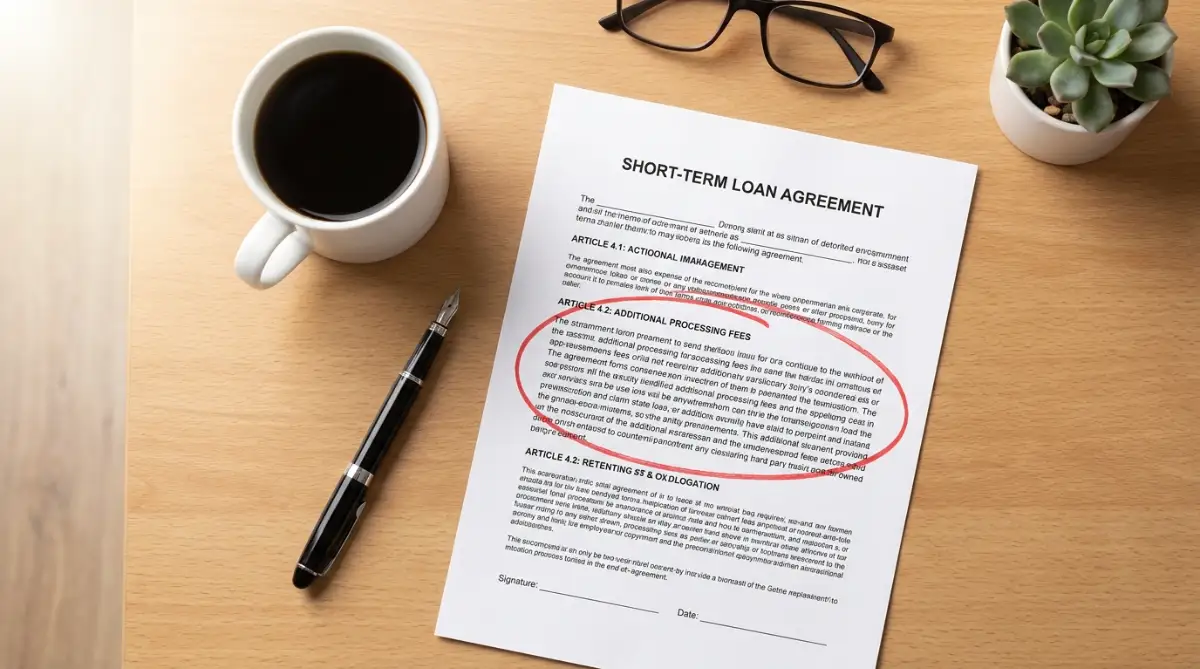
Decoding the Trap: Unmasking the Lender's Playbook
When you sit down to review a borrowing contract, you have to treat it like a strategic game. The lender wants to maximize their profit, and you want to minimize your overall cost. You cannot just look at the monthly payment amount and assume everything is perfectly fine.
The real danger always lives in the deepest paragraphs of the document. These are the sections printed in slightly lighter ink or buried under a boring headline. Let us break down the exact warning signs you need to look for before you ever hand over your signature.
The Illusion of the "Small Flat Fee"
One of the most common tricks in short-term agreements is completely avoiding the word "interest." Instead of showing you an interest rate, the contract will heavily promote a simple flat fee. They will tell you that it only costs fifteen dollars for every one hundred dollars you borrow.
To a stressed mind, fifteen dollars sounds like an incredibly cheap price to fix a major problem. However, you have to look at the math from a yearly perspective. This is known in the financial world as the Annual Percentage Rate, or APR.
If you pay fifteen dollars to borrow one hundred dollars for just two weeks, that math translates to an APR of almost 400%. If a credit card offered you a 400% interest rate, you would instantly throw the offer in the trash. You must always calculate the true yearly cost of that small flat fee.
I made the massive mistake of looking at the flat fee instead of doing the actual math during my first loan. I finally realized that a seemingly harmless twenty-dollar charge on a two-week term is mathematically worse than the most expensive credit card on the market. Always force the lender to show you the official APR in writing.
The Automatic Rollover Trapdoor
When you read through the repayment section, you must look closely for words like "renewal," "extension," or "rollover." This is the exact mechanism that keeps everyday people trapped in debt for years. A rollover clause simply means that if you cannot pay the full amount on the due date, the lender will just charge you another fee to extend the time.
If you want to see exactly how these interest cycles silently trap everyday people, this clear visual breakdown is an absolute must-watch.
Here is how the trap actually works in reality. You owe three hundred dollars, but you only have fifty dollars in your bank account on the due date. The lender takes your fifty dollars as a "renewal fee," but your actual debt remains at three hundred dollars.
You just paid money, but your balance did not go down by a single penny. Some contracts are written to trigger these renewals automatically unless you physically go to the store and cancel them in writing. If you see an automatic rollover clause, you should immediately walk away from the deal.
Hidden Prepayment Punishments
Logically, if you borrow money and pay it back ahead of schedule, you should be rewarded for being responsible. Unfortunately, the short-term lending industry does not operate on normal logic. Many of these contracts include a sneaky paragraph called a prepayment penalty.
Lenders make their money by collecting interest over a specific period of time. If you pay the debt off early, they lose out on their expected profit. To protect their own pockets, they write a rule that forces you to pay a large fine if you try to clear your balance before the final due date.
You have to scan the document for phrases like "early payoff fee" or "minimum interest requirement." Imagine getting a small bonus at work and deciding to clear your debt, only to find out the lender is going to charge you fifty extra dollars just for being responsible. A fair agreement will always allow you to pay off your balance early without any extra charges.
The Forced Bank Account Access Clause
This is perhaps the most frightening element found in modern lending documents. Look for a section titled "ACH Authorization" or "Electronic Funds Transfer." By signing this specific section, you are legally giving the lender the master key to your personal checking account.
They will tell you this is just for convenience, so you do not have to mail a physical check. In reality, it gives them the power to reach into your account and pull money out whenever they feel like it. If you miss a payment by even one day, they will aggressively try to draft the funds.
Think of it like leaving the front door of your house wide open for a complete stranger. If they attempt to pull the money and your account is empty, your bank will hit you with an expensive overdraft fee. The lender might try to pull the money three or four days in a row, resulting in hundreds of dollars in bank penalties.
You should always negotiate to pay by money order, physical check, or a manual online payment. If a lender absolutely refuses to give you the loan without direct access to your checking account, that is a massive warning sign.
Mandatory Arbitration and Giving Up Your Rights
Deep at the bottom of the document, usually near the signature line, you will often find a large block of text written entirely in capital letters. This section usually discusses a concept called "Mandatory Arbitration." Most people gloss right over it because it looks like boring legal jargon.
What this clause actually says is that you are voluntarily giving up your constitutional right to sue the lender in a real court of law. If they illegally overcharge you or harass your family, you cannot take them in front of a judge.
Instead, you are forced to resolve the issue through a private arbitrator. The catch is that the lender usually gets to pick the arbitrator, and the meetings happen behind closed doors. Statistics consistently show that private arbitrators rule in favor of the financial companies the vast majority of the time.
By signing this clause, you are essentially agreeing that the lender makes the rules and controls the punishments. While it is very hard to find a short-term contract without this clause, you should always ask if you can opt-out of the arbitration agreement. Some companies legally have to allow you to opt-out if you send them a written letter within thirty days of signing.
Vague Language Around Due Dates and Deadlines
You would think that a due date is a simple concept, but predatory contracts love to play games with time. You need to look very closely at how they define a "day" in the agreement. They will often switch between the terms "calendar days" and "business days" depending on what benefits them the most.
For example, if your payment is due in five business days, weekends and national holidays do not count. But if the contract says you have a three-day grace period in calendar days, the weekend suddenly counts against you.
This confusion is intentionally designed to make you accidentally miss a deadline. Once you miss that specific deadline, they can legally trigger massive late fees or instantly hike your interest rate to the maximum legal limit. Always force the agent to grab a physical calendar and point to the exact date your money is due.
Write that specific date down on your copy of the contract and have the agent initial it. This leaves zero room for debate if their computer system suddenly decides to charge you a late fee on a Sunday afternoon.
Aggressive Collection Tactics Written in Ink
Most people assume that if they fall behind on payments, the lender will just send a few polite letters in the mail. But short-term contracts often contain clauses that allow for incredibly aggressive collection behavior.
You need to read the section labeled "Default" or "Collection Practices." Many of these agreements include language where you give them permission to contact your employer to verify your job status.
Some will even hide a clause that allows them to call the personal references you listed on the application. Imagine the deep embarrassment of your boss or your mother receiving a phone call from an aggressive debt collector because you were three days late on a payment.
If you see language that allows them to contact third parties about your debt, you are looking at a highly predatory company. A reputable lender relies on your credit score and standard communication, not public humiliation, to get their money back.
The Danger of Add-On Insurance Products
As you get close to the final signature page, the contract might suddenly include extra charges for things you never asked for. These are often labeled as "Credit Life Insurance" or "Payment Protection Plans."
The agent will casually mention that these products protect you if you lose your job or get into an accident. What they do not tell you is that these insurance policies are wildly overpriced and almost impossible to actually use.
They sneak these fees into the total loan amount, meaning you are actually paying high interest on the insurance policy itself. Federal law clearly states that these add-on products must be strictly voluntary.
If an agent tells you that buying the insurance is a mandatory requirement to get approved, they are lying to you. You should immediately ask them to print a fresh contract with all the unnecessary insurance products completely removed.
Mastering the Art of Contract Negotiation and Protection
Understanding the dirty tricks lenders use is only half the battle. Now, you need to know exactly how to fight back and protect your hard-earned money. Most people assume that borrowing agreements are set in stone and completely non-negotiable.
This is a massive misconception that costs everyday consumers millions of dollars. The person sitting behind the desk is a salesperson, and they want your business. You actually have a surprising amount of power if you know exactly which buttons to push before signing.
The 24-Hour Cooling-Off Strategy
When you are facing a sudden financial emergency, your brain naturally wants to rush through the paperwork. You just want the cash in your hand so you can fix the immediate problem. Lenders know you are feeling desperate, and they use that urgency against you.
My biggest piece of advice is to completely remove the emotion from the room. Ask the agent to print out the entire contract, including all the terms and conditions. Then, calmly tell them you need to take it home for one night to review it.
If the agent becomes aggressive or tells you the offer expires in five minutes, that is your cue to walk out the door. A legitimate financial institution will never pressure you into signing a binding document on the spot. By taking the paper home, you give yourself time to actually read the fine print without a salesperson breathing down your neck.
While you are at home, you should aggressively search the internet for reviews about that specific company. Just like you need to spot fake remote jobs and protect your identity before sending a resume, you must investigate a lender before taking their money. Look for complaints filed with state regulators about unauthorized bank withdrawals.
Demanding a Physical Amortization Schedule
Whenever you borrow money, you should never guess how much your payments will be. You need a clear, mathematical roadmap that shows exactly where every single penny is going. This document is called an amortization schedule.
An amortization schedule breaks down your exact payment amounts week by week or month by month. It shows you exactly how much of your payment goes toward the principal balance and how much goes straight into the lender's pocket as interest.
If a lender refuses to print this schedule for you, they are likely trying to hide a massive balloon payment at the end of the term. The Consumer Financial Protection Bureau strictly mandates clear lending disclosures for all consumer loans. If the paperwork does not have a federal "Truth in Lending" box at the very top, you are dealing with a shady operation.
Do not let them confuse you by explaining the math verbally. Verbal promises mean absolutely nothing if they are not printed in black ink on the final document.
Building a Protective Wall Around Your Bank Account
As we discussed earlier, giving a short-term lender direct electronic access to your checking account is extremely dangerous. However, if you absolutely must use an automatic draft to get approved, you need a backup plan.
Never give them the routing number to your primary bank account where your paycheck is deposited. Instead, open a completely separate, free checking account at a different local bank. Only keep the exact amount of money needed for your loan payment in this secondary account.
This creates a protective firewall between the aggressive lender and your actual life savings. If they try to pull unauthorized fees, they will simply hit an empty account. Taking these small security measures is just as important as knowing why you should never leave your smart speaker microphone turned on inside your living room. You always want to control who has access to your private space.
Identifying Predatory State Law Violations
Every single state has its own specific laws that dictate how much interest a company can legally charge you. Predatory lenders frequently ignore these laws by setting up their company headquarters on tribal lands or overseas. They do this to claim they are immune to your local state regulations.
You need to act like a detective before you borrow. Check with your local Attorney General's office online to see the maximum allowable interest rate in your specific area. If the contract asks you to pay a rate that is higher than your state's legal limit, the entire agreement might be legally void.
The Federal Trade Commission regularly shuts down illegal lending operations that try to bypass state consumer protections. If you notice a lender trying to use a foreign address on their official paperwork, run far away.

The Financial Traps That Catch Desperate Borrowers
Even smart, highly educated people make terrible mistakes when they are stressed about money. When your back is against the wall, it is incredibly easy to justify a bad financial decision. However, falling into these common traps will turn a temporary cash shortage into a multi-year disaster.
The most heartbreaking part is that people usually realize their mistake the exact second the ink dries on the paper. Let us walk through the most dangerous pitfalls you must actively avoid.
Relying on Verbal Promises from Friendly Agents
When you walk into a lending office, the person helping you is usually very warm, smiling, and incredibly polite. They will ask about your day, sympathize with your car troubles, and make you feel totally comfortable. This friendly behavior is a highly practiced sales tactic.
They use this friendly attitude to make you drop your guard. When you ask them a hard question about a weird fee in the contract, they will wave their hand and say, "Oh, do not worry about that, we never actually charge that fee."
If it is written in the contract, they will absolutely charge you that fee the moment you slip up. A friendly smile does not overwrite a legally binding document. Believing a salesperson's verbal promise over the printed text is a devastating error.
Borrowing to Pay Off Another Short-Term Debt
This is the exact trap that causes everyday people to file for bankruptcy. Imagine you take out a small loan for five hundred dollars. Two weeks later, the payment is due, but you still do not have the money.
Instead of negotiating a payment plan with the first lender, you go down the street to a second lender. You borrow six hundred dollars to pay off the first debt. Now you have a brand new loan with an even higher interest rate and massive origination fees.
This cycle is an absolute death spiral for your finances. The Federal Deposit Insurance Corporation warns consumers that using one high-interest product to pay off another almost guarantees long-term financial ruin. You are simply digging a deeper hole to fill a smaller one.
Skimming the Final Signature Page
After reading two or three pages of dense legal jargon, your eyes start to glaze over. You just want the process to end. This is exactly when lenders slip in the most dangerous clauses.
They put the worst terms on the very last page, right above the signature line. This includes the arbitration agreements and the aggressive collection tactics we talked about earlier. Skimming the final page is like ignoring a tiny crack in your ceiling. What seems like nothing will eventually turn into silent rooftop damage and massive hidden repair costs.
Take a deep breath, grab a cup of coffee if you need it, and read every single word on that last page twice.
Assuming the Loan Will Build Your Credit Score
Many people justify taking out an expensive loan by telling themselves it will help build their credit profile. They think that making on-time payments will boost their score and help them buy a house later.
The ugly truth is that the vast majority of short-term, high-interest lenders do not report your positive payments to the major credit bureaus. They simply do not want to pay the administrative fees required to report good behavior.
However, if you miss a single payment, they will immediately send your account to a dirty collection agency. That collection agency will absolutely report the negative mark to your credit file. You get absolutely none of the benefits of borrowing, but you take on 100% of the risk.
Providing Too Much Personal Information
When you fill out the initial application, the lender will ask for a mountain of personal data. They want your social security number, your employer's direct phone number, and the names of three close relatives.
People blindly hand this information over without a second thought. If the lender's digital security is weak, your private data can easily be stolen by hackers. Think about what happens when an e-commerce SSL certificate expires — sensitive customer data gets instantly compromised.
Never give out your relatives' phone numbers unless it is legally required for the application. The lender only wants those numbers so they can harass your family if you fall behind on payments.
Falling for the Unsecured Wi-Fi Trap
If you are applying for an emergency loan online, you must be hyper-aware of your digital surroundings. Sometimes people panic while sitting in a coffee shop or waiting at an airport, and they start typing their bank routing numbers into a loan application on public Wi-Fi.
This is incredibly dangerous. Hackers monitor these public networks specifically to steal financial credentials. You might think you are solving your money problem, but you are actually exposing yourself to the hidden dangers of using free airport Wi-Fi. Always wait until you are on a secure, password-protected home network before submitting any financial documents.
Real Answers to Your Borrowing Doubts
Can I legally cancel a loan right after I sign the papers?
Yes, in many cases you actually can. The federal Truth in Lending Act provides a "Right of Rescission" for certain types of loans. This legally gives you three business days to completely cancel the agreement and return the money without paying any interest or penalties. Always check if your specific loan qualifies for this rule.
What happens if I just close my checking account to stop their automatic payments?
Closing your bank account does not make the debt disappear. The lender will still attempt to draft the money, which can result in severe overdraft fees before the account officially closes. Afterward, they will simply send the remaining debt to an aggressive collection agency, which will destroy your credit score.
Are hidden fees actually legal for them to charge?
Unfortunately, yes. They are usually completely legal because they are not actually "hidden" in the eyes of the law. They are clearly printed in the contract you signed, even if the text was incredibly small or confusing. Your signature acts as legal proof that you agreed to pay those specific fees.
Will paying off a short-term loan early save me money?
It entirely depends on the contract. If the agreement uses simple interest, paying it off early will definitely save you a lot of money. However, if the contract includes a "precomputed interest" clause or an early payoff penalty, you might have to pay the full interest amount regardless of when you settle the balance.
How much should a safe emergency loan actually cost?
Consumer protection experts universally agree that a fair, affordable loan should never exceed an Annual Percentage Rate (APR) of 36%. Any loan that charges an APR higher than 36% is generally considered predatory and will likely cause you severe financial harm in the long run.
Your Blueprint for Safe and Smart Borrowing
Navigating the world of short-term lending does not have to be a terrifying experience. You are not at the mercy of greedy financial institutions as long as you arm yourself with the right knowledge. You now know exactly how to look past the friendly smiles and read the actual math printed on the page.
The next time you find yourself in a cash crunch, take a deep breath and slow down. Demand to see the official APR, check for automatic rollover clauses, and aggressively protect your bank account from unauthorized drafts. Remember, a bad loan is much worse than having no money at all.
If you want to keep sharpening your financial defense skills, you can always explore more advanced guides and insights on our main website to stay one step ahead of the system.
I know exactly how stressful it feels to stare at a confusing contract while your bank account is empty. But I also know the incredible feeling of relief when you finally spot a hidden trap and confidently walk away from a terrible deal. You have the power to protect your financial future, so trust your gut, read the fine print, and never let anyone rush your signature.
Disclaimer: The information provided in this blog post is for educational and informational purposes only and does not constitute financial, legal, or professional advice. Lending laws, interest rate caps, and contract regulations vary widely by state and jurisdiction. Always consult with a certified financial advisor or a qualified legal professional to discuss your specific personal situation before signing any legally binding agreements or borrowing money.
![Warning: Never Co-Sign a Family Loan Before Reading This [Step-by-Step]](https://pixeljournals.com/storage/uploads/blogs/1786290760_warning-never-co-sign-a-family-loan-before-reading-this-step-by-step.webp)