The Hidden Cost of Trusting the Wrong People
I will never forget the overwhelming anxiety I felt during my very first major online financial transfer. I had saved my money for months and finally decided to move a large portion of my funds into a new investment platform. I carefully filled out all the complicated forms, double-checked the account numbers, and confidently hit the submit button. My money instantly disappeared from my bank account, but it did not show up on the investment platform. For three agonizing days, my hard-earned savings were completely stuck in a dark, invisible void controlled by a third-party clearinghouse.
I spent hours on hold listening to terrible waiting music, just trying to find a human being who could tell me where my money actually went. The customer service agents were completely unhelpful, reading from robotic scripts while I was literally losing sleep out of sheer panic. I realized right then that our entire traditional financial system relies on blindly trusting strangers with our wealth. We pay these massive corporations ridiculous fees simply to act as slow, inefficient middlemen.
This exact struggle happens to millions of regular people every single day across the globe. You work incredibly hard for your money, but the moment you try to use it, you are forced to jump through endless corporate hoops. You have to wait for business hours, observe bank holidays, and pay hidden transaction fees that eat away at your profits.
The mental toll of this constant financial friction is incredibly heavy. It leaves you feeling completely powerless over your own financial destiny. You constantly worry if a bank will freeze your account or if a broker will suddenly change their rules without warning.
When you cannot freely control your own assets, you never truly experience true peace of mind. We have accepted this broken system for generations simply because we never had a better option.
Escaping the Middleman Trap
To break free from this frustrating system, we need to completely change how financial agreements are processed. For centuries, every single transaction required a wealthy middleman to sit in the middle and guarantee the deal. Now, we finally have a mathematical way to enforce agreements without asking a banker for permission.
This brings us to the core concept of automated digital agreements. By using basic computer logic, we can replace the slow, expensive human middleman with a perfectly honest piece of software. Let us break down exactly how this technology works and how you can safely use it to grow your wealth.
What Exactly Is a Smart Contract?
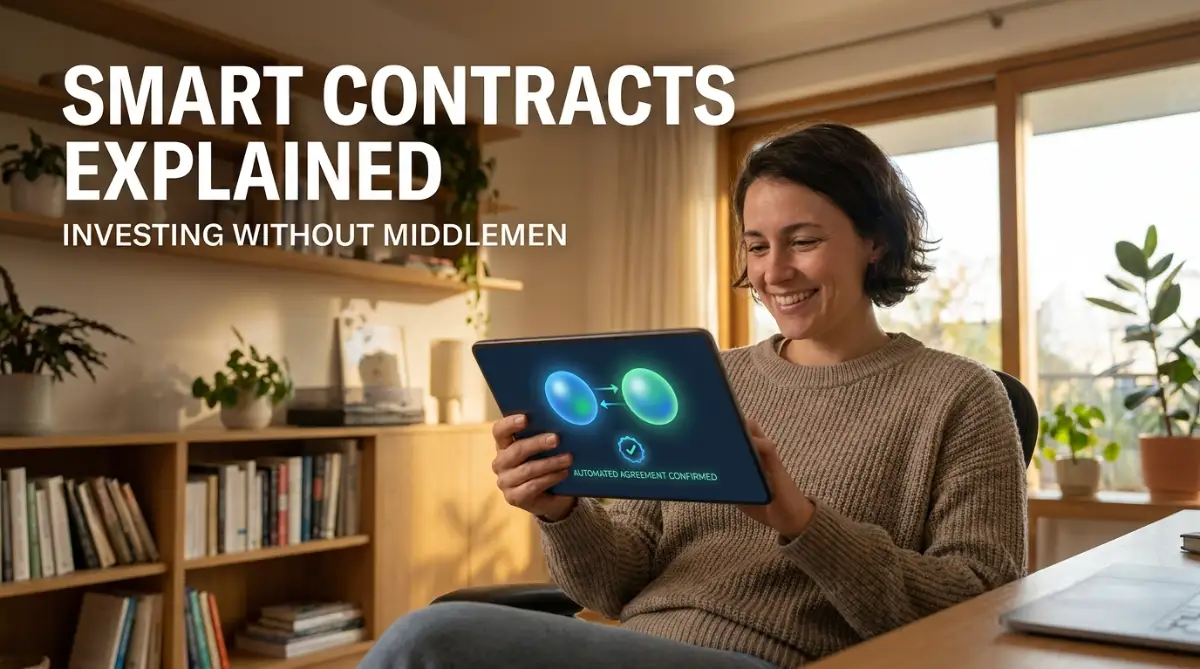
The name itself sounds incredibly complicated, making many normal investors feel entirely intimidated. However, there is absolutely nothing "smart" or artificially intelligent about these programs. They are actually very simple, highly predictable digital rules written directly into a blockchain network.
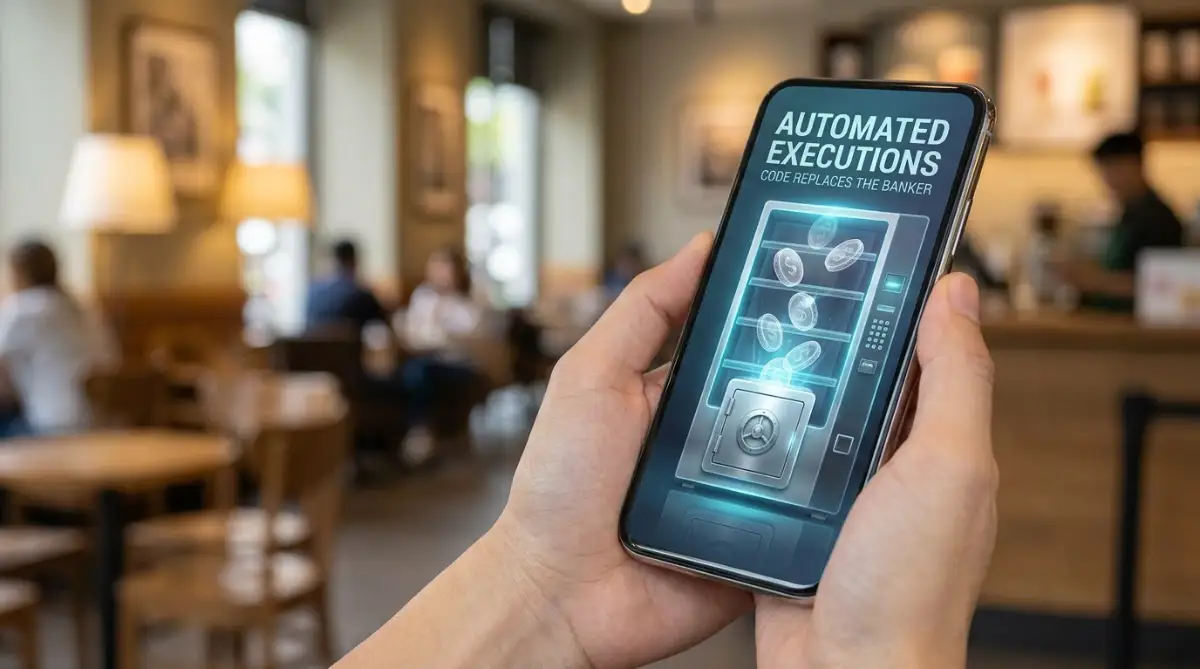
Think of it exactly like a modern vending machine sitting in an airport. When you walk up to a vending machine, you do not have to negotiate with a cashier or sign a legal document. You simply put your money into the slot, press the button for a bottle of water, and the machine automatically drops your item.
The vending machine is programmed with a very specific set of rules based on the "If-This-Then-That" concept. If you insert two dollars, then the machine releases the water. If you only insert one dollar, the machine simply rejects the transaction and hands your money back.
A smart contract does this exact same thing, but for digital money and digital assets. It holds funds safely in a virtual vault and only releases them when a highly specific condition is perfectly met. Because it runs on a decentralized network, nobody can physically unplug the machine or cheat the system.
How Automated Executions Protect Your Money
In the traditional investing world, when you want to buy a specific asset, you hand your money to a broker. You are entirely trusting that the broker will actually deliver the asset to your account. If that brokerage firm suddenly goes bankrupt overnight, your money might be locked up in long legal battles for years.
Automated executions completely eliminate this terrifying risk. When you use a decentralized digital exchange, you interact directly with a smart contract. You send your digital coins to the contract, and the contract simultaneously sends the new investment asset back to your private wallet.
These two actions happen at the exact same millisecond. If the contract does not have the asset you want, it cannot take your money. It is an all-or-nothing digital handshake.
This means you never have to trust the person on the other side of the trade. You do not need to know their name, their credit score, or their physical location. You only have to trust the open, transparent mathematics running the computer network.
Here is a Pro Tip straight from my own early investing mistakes: I used to blindly connect my main digital wallet to random new platforms just to try out their services. I quickly realized that approving a smart contract permits it to interact with my funds, and not all contracts are safe. My biggest lesson was setting up a separate, mostly empty "burner wallet" specifically for testing new contracts, keeping my main savings entirely disconnected and safe.
The Real Cost Savings for Everyday Investors
One of the most immediate benefits you will notice is how much money stays in your own pocket. Traditional financial institutions have massive physical buildings, thousands of employees, and expensive marketing campaigns. They pay for all of this overhead by taking a small slice out of every single trade you make.
Because a smart contract is just lines of computer code running automatically on a network, the overhead cost is incredibly low. There is no CEO taking a massive yearly bonus, and there are no physical office buildings to maintain. The network operates twenty-four hours a day, seven days a week, without ever requiring a coffee break.
When you remove all these human expenses, the financial efficiency becomes amazing. Instead of paying a broker a massive fee to manage your money, those extra profits go directly back to the users. This is exactly why everyday investors can often find much better return rates in the digital space compared to a local neighborhood bank.
Before we go any further, watching a visual breakdown of this process will make everything click in your mind perfectly. Check out this incredibly simple visual explanation below that perfectly shows how these automated agreements protect your money in real-time.
Real-World Scenarios: Borrowing and Lending
To truly grasp the power of this technology, let us look at a highly practical scenario that normal people face. Imagine you need a short-term loan to cover an unexpected medical bill. If you go to a traditional bank, you have to submit endless paperwork, undergo a harsh credit check, and wait weeks for an approval committee.
If the bank employee is having a bad day, or if they simply do not like your financial history, they will reject you instantly. The entire process is slow, deeply personal, and highly judgmental.
Now, imagine using an automated digital lending contract instead. You simply deposit some of your digital assets into the smart contract as a form of security collateral. The contract instantly calculates how much you are allowed to borrow based on your deposit.
You click a single button, and the loan is deposited into your wallet within five seconds. There are no background checks, no credit scores, and absolutely zero human bias. The computer code treats a billionaire and a minimum-wage worker exactly the same way.
When you are ready to pay the loan back, you simply send the funds back to the contract. The contract automatically unlocks your collateral and returns it to your possession. The entire cycle is perfectly smooth, entirely private, and incredibly empowering for the user.
Understanding the Gas Fee Mechanic
While this system sounds entirely perfect, there is one major mechanic you must understand to avoid frustration. Running these automated contracts requires massive amounts of computing power from thousands of computers around the world. These computer operators do not work for free.
Whenever you want a smart contract to execute a task for you, you have to pay a small network usage fee. In the digital world, this is commonly referred to as a "gas fee." You are essentially paying for the digital fuel required to process your mathematical agreement.
These fees can change rapidly based on how busy the network is at any given moment. If thousands of people are trying to use the same network at the exact same time, the price of digital fuel will naturally rise.
As a smart investor, you can easily save money by timing your automated executions. If you need to interact with a contract, try doing it during quiet hours, like early Sunday mornings. You will often pay significantly less for the exact same transaction simply because the digital traffic is much lighter.
The Importance of Open Source Transparency
In the traditional world, the contracts you sign are often filled with highly confusing legal jargon. Companies intentionally use difficult language to hide secret clauses and hidden penalty fees. Unless you can afford an expensive lawyer, you never truly know what you are agreeing to.
Smart contracts flip this entire model entirely upside down. The code that controls the digital agreement is almost always open source. This means anyone in the world can openly read the exact rules written into the program before they ever deposit a single penny.
You might be thinking, "I do not know how to read computer code, so how does this help me?" The beauty of the decentralized community is that independent security experts constantly review these contracts. They publicly audit the code to ensure there are no hidden tricks or security flaws.
When you use a highly popular, heavily audited contract that has been running safely for years, you benefit from the combined intelligence of the entire community. You get absolute transparency instead of empty corporate promises.
Why Immutability is Your Best Friend
Once a smart contract is officially launched onto a major decentralized network, it generally cannot be changed or altered. This permanent state is known as immutability. This specific feature is exactly what provides the incredible security everyday investors require.
Imagine signing a contract to buy a physical house, but the seller secretly changes the agreed price right before the final signature. In the physical world, this leads to massive legal arguments and expensive lawsuits. In the digital world, the code simply stops this from ever happening.
Because the rules are permanently locked in, you have an absolute mathematical guarantee that the contract will execute exactly as written. The developer who created the contract cannot suddenly change their mind and take your money. The rules apply equally to everyone, and nobody can bend them for personal gain.
This immutability creates a highly trusted environment in a completely trustless digital space. You do not need to trust the person who wrote the code, because you know the network will force the code to run perfectly every single time.
By understanding these foundational concepts, you immediately put yourself ahead of ninety percent of traditional investors. You are no longer just blindly handing your money to middlemen and hoping for the best. You are actively taking control of your financial energy using the most secure, transparent tools ever created.
Pro-Level Strategies for Managing Digital Agreements
Once you understand how these automated digital agreements function, you need to learn how to manage them like a seasoned professional. The underlying technology is mathematically perfect, but the way you interact with it determines your long-term success. Many beginners simply connect their wallets to random applications and hope for the best.
That approach is extremely risky and often leads to unnecessary financial losses. To build true, lasting wealth in this space, you must adopt a highly defensive mindset. Think of your digital wallet exactly like your physical bank account, and treat every interaction with the utmost respect.
Let us explore the advanced, practical habits that successful investors use to protect their assets while maximizing their daily returns.
Mastering the Art of Digital Permissions
When you want to use a decentralized application, the smart contract will ask you for permission to access your digital coins. This step is incredibly common, but it is also where most everyday investors make their biggest oversight. The default setting on many applications asks for "infinite approval," meaning the contract can access an unlimited amount of your specific coin forever.
Imagine going to a restaurant and handing the valet the keys to your car, but also giving them the legal title to your house. That is exactly what an infinite approval does in the digital world. If that specific application ever gets hacked in the future, the hackers can use that infinite approval to drain your wallet completely.
You should always manually edit your permission settings before you click the confirm button. Only approve the exact dollar amount you intend to use for that specific transaction on that specific day. It might cost you an extra few cents in network fees to do this, but it guarantees your remaining savings stay completely safe from future exploits.
The Power of Routine Access Revocation
Even if you are incredibly careful with your permissions, it is completely normal to accumulate dozens of approved contracts over a few years. You might test a new decentralized exchange once and completely forget about it a week later. Leaving these old permissions active is just like leaving your digital doors open to unauthorized access in your own home.
Professional investors make it a strict habit to clean out their digital permissions on a regular basis. There are many safe, free tools available that scan your public wallet address and show you exactly which contracts still have access to your funds. You can click a single button to officially revoke those old permissions, instantly locking the digital door behind you.
I highly recommend setting a reminder on your calendar to perform a full permission cleanup on the first day of every single month. By making this a regular part of your financial routine, you drastically reduce your exposure to hidden dangers. You would never ignore ignoring basic security protocols in a traditional business, so do not ignore them in your personal portfolio.
Leveraging the Strength of Hardware Integration
We talked earlier about how automated executions remove the need for a traditional human broker. However, you still need a highly secure way to physically authorize these digital handshakes. Relying solely on software installed on your mobile phone or laptop is generally not safe enough for large amounts of money.
To reach the highest level of security, you must integrate a physical hardware device into your daily strategy. A hardware wallet keeps your private security keys completely isolated on a separate, offline microchip. When a smart contract asks you to confirm a trade, you have to physically press a button on your hardware device to approve the mathematical execution.
Even if your main computer is infected with hidden malware, the hackers cannot authorize the transaction without physical access to your hardware device. For a deeper understanding of hardware encryption standards, you can read the advanced cryptographic research published by the National Institute of Standards and Technology (NIST). Using this offline method provides an incredible sense of mental peace when you are sleeping at night.
Reading the Security Room Without Being a Programmer
You do not need to know how to write complex computer code to verify if a decentralized application is actually safe to use. You simply need to know where to look for the professional security reviews. Every reputable project will hire external cybersecurity firms to aggressively attack their code and look for weaknesses.
When a project passes these intense security tests, the auditors publish a highly detailed public report. You should always look for a link to the official audit report on the project's main website before you deposit any money. If you cannot easily find an audit from a recognizable security firm, you should immediately walk away from that platform.
You can also rely on major university research to guide your understanding of safe network practices. Institutions like the Initiative for Cryptocurrencies and Contracts (IC3) regularly publish easily readable papers on how these systems protect everyday users. Letting academic experts do the heavy technical lifting is a very smart way to navigate this complex space.
Organizing Your Wealth into Distinct Silos
One of the best expert secrets is never keeping all your digital eggs in a single mathematical basket. If you interact with dozens of different automated contracts using your main savings wallet, you are mixing your highly secure assets with highly experimental applications. If just one of those new applications has a hidden flaw, your entire life savings is suddenly at risk.
The smartest way to operate is to create two entirely separate digital wallets. Wallet A is your "deep cold storage" vault, which holds the vast majority of your long-term wealth. You never connect Wallet A to any external application, and you never use it to sign complex digital agreements.
Wallet B is your "daily spending and trading" wallet, which only holds a very small percentage of your overall funds. You use Wallet B to interact with exciting new platforms, automated lenders, and digital exchanges. If Wallet B ever encounters a malicious contract, the maximum possible damage is limited to just a tiny fraction of your overall portfolio.
The Devastating Errors That Erase Portfolios
Even with the best security habits in place, human error is always the weakest link in any financial system. Because there is no customer service hotline to call when a digital transaction goes wrong, simple mistakes carry incredibly heavy consequences. The decentralized world is completely unforgiving to those who rush blindly into agreements they do not understand.
I have spoken to incredibly smart, successful business owners who lost years of hard-earned savings simply because they clicked a button while they were distracted. We need to clearly identify these devastating emotional traps so you can easily sidestep them on your own journey.
Blindly Trusting Fake Customer Support
When you experience a technical glitch on a decentralized platform, your immediate instinct is to ask for help on social media. You might post a question in a community forum asking why your automated transaction is taking so long to complete. Within minutes, a friendly-sounding person claiming to be "Official Support" will send you a private message offering immediate assistance.
They will sound highly professional and empathetic, telling you that you simply need to "re-sync your digital wallet" to fix the problem. They will send you a link to a completely fake website that looks exactly like the real platform. The moment you connect your wallet and sign the fake contract they provide, your entire account will be instantly drained.
You must remember that genuine decentralized applications do not have active customer support agents monitoring social media. You have to train your brain to quickly spot fake opportunities and entirely ignore anyone who sends you an unexpected direct message about your money. According to the Global Anti-Scam Alliance, fake support impersonation is one of the leading causes of financial loss in the digital economy.
Ignoring the Realities of Network Congestion
Another massive mistake happens when investors try to force a transaction through during moments of extreme market panic. When global financial news breaks, thousands of people rush to the exact same decentralized exchange simultaneously. This creates a massive traffic jam on the network, causing the required automated processing fees to skyrocket.
In these moments, beginners often get highly impatient and aggressively click the submit button multiple times. They think the system is simply frozen, but they are actually submitting the same expensive transaction over and over again. By the time the network clears the traffic jam, they realize they just paid hundreds of dollars in entirely unnecessary network fees.
You must learn to practice extreme patience when the network is heavily congested. Do not stop delaying important tasks regarding your long-term plan, but absolutely delay pushing buttons when the digital traffic is terrible. Unless your trade is an absolute life-or-death emergency, waiting just twelve hours will usually save you a significant amount of money.
Falling for the "Urgent Upgrade" Trap
Scammers often rely on creating a false sense of extreme urgency to make you drop your standard security defenses. You might receive an email or see a targeted advertisement claiming that a popular smart contract is undergoing an "urgent security upgrade." The message will warn you that you will permanently lose your stored funds if you do not migrate your assets immediately.
Because you are terrified of losing your money, you click their provided link and sign a new digital agreement without thinking logically. This is the equivalent of letting a complete stranger into your house just because they are wearing a fake inspector's badge. Real, decentralized networks almost never require immediate, panic-driven action from everyday users.
If you ever see a message demanding urgent action regarding your digital wealth, immediately step away from your computer. Take a long walk, calm your nervous system, and then independently verify the information by visiting the project's official, established website. Acting out of pure fear is the absolute fastest way to completely destroy your financial future.
The Disaster of the Simple Typo
Because automated executions rely entirely on perfect mathematical accuracy, a simple spelling mistake can cause permanent disaster. When you send funds to a specific contract address, you have to provide a long string of random letters and numbers. If you accidentally delete just one single character from that long address, the transaction will still execute, but the money will go into a completely inaccessible digital black hole.
There is no bank manager who can reverse the transaction and retrieve your lost funds. Once the mathematical agreement is confirmed by the network, the transfer is entirely permanent and completely irreversible. This single reality causes more anxiety for new investors than almost anything else in the digital space.
To prevent this terrible outcome, you must treat every single transfer like a highly sensitive operation. Always copy and paste the address, and then manually verify the first four characters and the last four characters before you click confirm. You would never sign a traditional contract that contained hidden structural damage, so never approve a digital transfer without double-checking the exact destination.
Assuming All Applications are Created Equal
A very dangerous mindset for beginners is assuming that just because a platform uses automated contracts, it is automatically safe. The underlying blockchain network might be perfectly secure, but the individual application built on top of it could be written terribly. Anyone in the world can write a smart contract and publish it to the network in less than ten minutes.
If you rush to put your money into a brand-new, completely untested application just to earn a slightly higher interest rate, you are playing with fire. The code might contain accidental errors that lock your funds forever, or the developer might have intentionally hidden a malicious backdoor. Using unverified platforms is just like doing your secure banking while connecting to unverified public networks at an airport.
Always stick to the largest, most battle-tested applications that hold billions of dollars in public value. These massive platforms have been running flawlessly for years and are constantly monitored by the best security researchers on the planet. The extra one percent in profit you might make on a shady new platform is never worth risking your entire principal investment.
Your Personal Action Plan for Tomorrow
You now hold a deep, practical understanding of how automated executions are completely changing the financial world. You know exactly how these digital agreements remove the slow, expensive middlemen and give you direct control over your own money. More importantly, you understand the strict security habits required to navigate this space safely and confidently.
The transition from a traditional bank to a completely decentralized network can feel slightly intimidating at first, but it is an incredibly empowering journey. You are no longer just a passive customer paying arbitrary fees to a massive corporation. You are now a sovereign individual, using open mathematics to secure your family's long-term financial future.
My strongest advice for you is to start incredibly small tomorrow morning. Find a highly reputable, thoroughly audited platform, and execute a tiny, five-dollar transaction just to watch the magic happen in real-time. Once you experience the beautiful speed and absolute transparency of a perfect automated execution, you will never want to go back to the old, broken banking system again.
Common Questions About Automated Agreements
Are smart contracts legally binding in the real world?
The legal status of automated digital agreements varies heavily depending on your specific country and local jurisdiction. While the computer code mathematically forces the digital transaction to happen, enforcing real-world consequences often requires traditional legal backing. Always consult a local legal professional if you are using these systems for major physical business deals.
Can an automated execution be hacked or manipulated?
The underlying blockchain network is virtually impossible to hack, but poorly written individual contracts definitely can be exploited. If a developer makes a coding mistake, malicious actors can use that specific flaw to drain the funds held within that single contract. This is exactly why you must only use platforms that have been heavily audited by professional security firms.
Do I have to pay fees if the execution completely fails?
Yes, you generally still have to pay a small network fee even if your transaction is rejected. The computers on the network still had to burn energy to process your request and determine that it failed. You can easily avoid failed transactions by always ensuring you have enough digital fuel in your wallet to cover the estimated costs.
What happens if I lose my internet connection during a trade?
Your personal internet connection dropping will not damage an ongoing execution. Once you successfully sign the transaction and broadcast it to the broader network, the global computers take over completely. You can shut your laptop immediately, and the network will continue processing the agreement exactly as written.
Are these digital agreements completely anonymous?
They are highly private, but they are not entirely anonymous. Every single automated execution is permanently recorded on a public digital ledger for anyone to see. While your real name is not attached to the transaction, forensic experts can often trace the movement of funds back to a specific individual if required by law enforcement.
Disclaimer: The information provided in this blog post is strictly for educational and informational purposes only and does not constitute financial, investment, legal, or technical advice. Digital asset markets are highly volatile, and interacting with automated contracts carries inherent technical risks. You should always conduct your own thorough research or consult with a licensed financial professional before making any investment decisions. I am not responsible for any financial losses or technical errors you may incur.