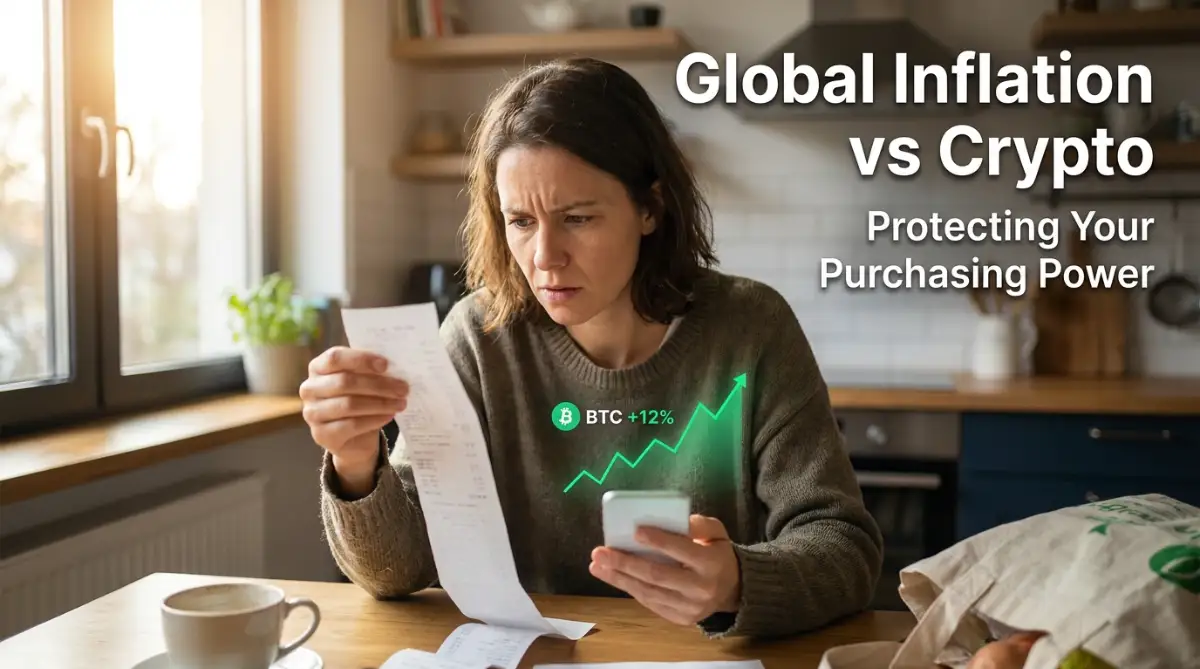
The Silent Thief Emptying Our Pockets Every Single Day
I stood at the grocery store checkout counter staring at a tiny bag of everyday essentials, completely shocked by the total price flashing on the screen. My heart sank instantly as I realized my standard weekly food budget was now buying exactly half of what it used to. I had been working overtime for months, saving every single penny, yet I somehow felt poorer than ever before. Later that night, I opened my digital currency app, desperately hoping to find some kind of logical financial safety net. Instead, I just felt a deep, overwhelming confusion about how global economic panic actually affects these digital coins. I felt like I was playing a complex financial game where a hidden banker kept changing the rules while I was sleeping.

This exact feeling of absolute helplessness is quietly destroying the mental peace of millions of hardworking families right now. You go to your job every day, you put in the heavy effort, and you expect your savings to protect your family's future.
Instead, you watch helplessly as the cost of housing, fuel, and basic food items skyrockets out of control. It feels like you are running as fast as you can on a treadmill, but someone keeps turning up the speed until you can barely breathe.
When traditional money loses its purchasing power, it creates a massive wave of daily anxiety that affects every single decision you make. You start second-guessing basic purchases, worrying if you will have enough money left over for an unexpected medical bill.
This financial stress ruins your sleep, damages your personal relationships, and completely steals your joy. People naturally start looking for alternative ways to store their hard-earned value, which leads them directly to the complex world of decentralized digital money.
However, moving into digital assets brings its own unique type of mental stress and intense confusion. You hear completely conflicting stories on the news every single day about how these assets react to rising global prices.
One expert says digital coins are the ultimate protection, while another expert claims they will completely crash when prices go up. We need to clear up this massive confusion and look at what is actually happening behind the digital curtain.
The Mechanical Connection Between Rising Prices and Digital Wealth
To truly understand how decentralized money reacts to economic panic, we have to break down the mechanics of both systems. We cannot make smart financial choices if we do not understand how the underlying gears actually turn.
Many people mistakenly believe that digital coins exist in a completely separate universe from traditional money. In reality, these two financial systems are deeply connected, constantly pushing and pulling against each other based on human psychology.
How Traditional Money Slowly Melts Away
Let us start by looking at why your grocery bill keeps getting more expensive every single month. It is not because the apples and bread are magically becoming more valuable or harder to grow.
The real issue is that the paper money in your wallet is constantly losing its core value. Governments around the world regularly create completely new money out of thin air to pay for massive national debts.
Think of traditional money like a large pot of incredibly delicious, rich soup. If you keep adding plain water to that pot to make it feed more people, the soup loses its strong flavor and becomes weak.
This is exactly what happens when central banks print more currency; the money you already own gets completely watered down. Your boss might give you a small raise, but if the money itself is worth less, your actual purchasing power continues to drop.
The Mathematics of True Digital Scarcity
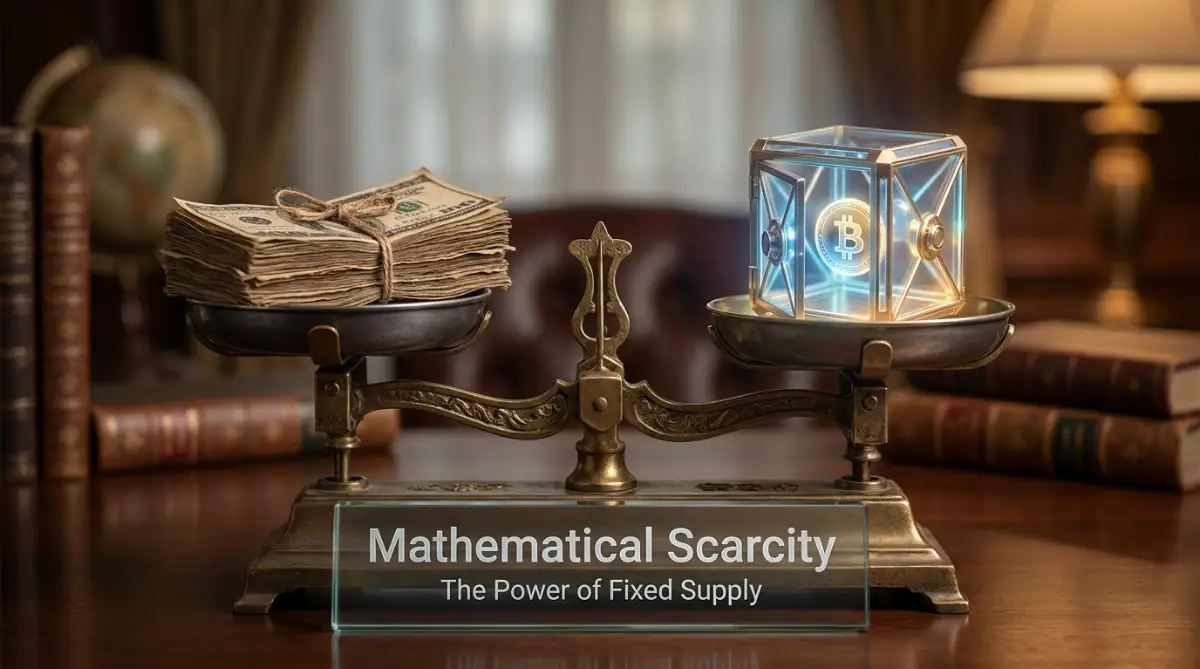
Now, let us compare that watered-down soup to the fundamental design of a decentralized digital currency. The most popular digital networks were specifically built with a strict mathematical rule that cannot be changed by any politician.
There is a hard, absolute limit on the total number of coins that will ever exist in that specific network. Nobody can magically create more coins just because they want to pay off a bad debt.
Because the supply is strictly fixed, these digital assets behave much more like physical gold than paper money. When global inflation hits hard and traditional money loses its value, investors naturally look for things that have a limited supply.
They want to move their melting paper wealth into a solid, unchangeable digital vault. This basic law of supply and demand is the main reason why people view decentralized assets as a long-term life raft.
Here is a Pro Tip straight from my own early investing mistakes: I used to think keeping stacks of cash in a secure physical safe was the ultimate way to protect my family. I eventually realized my metal safe was actually acting like a slow-melting ice block, silently destroying my purchasing power year after year. Understanding that holding cash is a guaranteed loss completely changed how I look at scarce digital assets.
Understanding the Short-Term Emotional Panic
If decentralized money has a fixed supply, you might wonder why the price sometimes drops wildly when global inflation is announced. This is where human emotion completely overrides mathematical logic in the short term.
When inflation reports come out and the numbers are terrifyingly high, everyday people panic about their immediate survival. They worry about paying their mortgage next week, not about protecting their wealth ten years from now.
In moments of extreme global fear, investors tend to sell off their volatile digital assets to hold cash for emergencies. Large financial institutions also sell their digital holdings because their borrowing costs suddenly become much higher.
This massive wave of fear-based selling naturally drives the price of digital assets down very quickly. It looks like the digital currency is failing, but it is actually just humans reacting poorly to traditional financial stress.
If you want to see exactly how these market emotions play out in real-time, this is a must-watch resource. Check out this incredible visual explanation below that perfectly breaks down the hidden mechanics of inflation and asset prices.
The Long-Term Horizon vs The Daily Noise
To become a successful participant in the digital economy, you have to separate short-term fear from long-term mechanics. In a window of three to six months, decentralized assets can easily lose value simply due to global panic.
However, if you zoom out and look at a five-year horizon, the picture looks completely different. While traditional currencies consistently lose purchasing power over a decade, strictly scarce digital assets generally follow an upward adoption curve.
Let us look at a simple scenario to make this concept perfectly clear. Imagine a hard-working carpenter named David who saves ten percent of his income every month.
If David saves in traditional fiat money, he will slowly realize he can buy fewer tools with his savings after five years. If he saves in a decentralized asset with a capped supply, the short-term bumps will be terrifying, but the long-term scarcity protects his energy.
The Impact of Central Bank Interest Rates
You cannot talk about global inflation without talking about the heavy hand of central banks. When prices spiral out of control, central banks try to fight back by heavily increasing interest rates.
When interest rates are high, traditional savings accounts suddenly start paying attractive yields to regular people. Borrowing money also becomes incredibly expensive, which slows down the entire global economy.
During these periods of high interest rates, many people pull their money out of digital networks and put it back into traditional banks. They prefer the guaranteed, boring return of a bank account over the wild rollercoaster of the digital market.
This migration of wealth puts a heavy downward pressure on digital asset prices. Decentralized currencies often struggle to gain momentum when traditional banking systems are offering high, risk-free rewards.
What Happens When the Money Printers Restart
The global economy cannot survive high interest rates forever without completely collapsing under the weight of debt. Eventually, something in the traditional financial system breaks, and central banks are forced to lower rates again.
When they lower rates, they usually start printing massive amounts of new money to stimulate the broken economy. This exact moment is when decentralized digital currencies typically show their true mathematical strength.
As soon as the market realizes that traditional money is about to be watered down again, wealth floods back into scarce digital assets. Smart investors anticipate this cycle and move their capital into decentralized networks before the money printers fully turn on.
Myth vs Reality: The Inflation Debate
There is a lot of terrible information spread across social media regarding how these digital networks actually perform. People often make extreme, emotional claims that are not backed up by historical market data.
Let us look at a clear breakdown of the most common myths compared to the actual reality of the market.
This simple table proves that you must approach this market with highly realistic expectations. If you expect a digital coin to magically offset your high electric bill next week, you will be deeply disappointed.
However, if you are looking to protect the purchasing power of your life savings over the next ten years, the mathematics heavily favor decentralization.
The Real Meaning of Financial Sovereignty
Beyond just the price charts and inflation numbers, decentralized money offers something much more profound. It offers you complete ownership and control over your own financial energy.
When you keep your wealth in a traditional banking system, you are essentially asking for permission to use your own money. The bank can freeze your account, limit your withdrawals, or charge you massive fees just to move your funds.
Furthermore, your wealth is entirely tied to the success or failure of your specific local government's economic policies. If your local currency hyper-inflates, your traditional savings are completely wiped out, regardless of how hard you worked.
Decentralized networks exist outside the control of any single government or central bank authority. As long as you securely hold your own private keys, nobody can ever dilute your wealth or block your transactions.
This absolute financial independence is the ultimate protection against the unpredictable chaos of global economic mismanagement. It is not just about making a quick profit; it is about permanently securing your financial human rights.
Elite Strategies to Shield Your Purchasing Power
Now that you understand how global economic panic impacts the digital market, we need to talk about real protection. Surviving a massive wave of rising prices requires a very specific, calculated game plan. You cannot simply buy a random digital coin and expect it to magically pay your expensive grocery bills the next morning.
To actually protect your family's financial future, you have to start thinking like a professional wealth manager. This means setting up automated systems that protect you from your own emotional reactions when the news gets scary. Let us break down the exact strategies that smart investors use to preserve their purchasing power over the long run.
Mastering the Art of Automated Accumulation
The single best way to fight a melting fiat currency is to completely remove your daily emotions from the equation. When inflation reports hit the news, human beings naturally want to panic and stop investing. Your brain will tell you to hold onto every single paper dollar you have, even though those dollars are rapidly losing their value.
To bypass this mental trap, you must set up an automated buying schedule, widely known as dollar-cost averaging. You simply set your bank account to automatically purchase a small, fixed amount of a strictly scarce digital asset every single week. It does not matter if the market is crashing or hitting new highs; your automated system just quietly goes to work.
By removing the daily decision-making process, you completely eliminate the stress of trying to time the chaotic market. The National Bureau of Economic Research has published extensive psychological studies showing that investors who automate their habits experience significantly less financial anxiety. Over a five-year period, this boring, robotic strategy almost always outperforms people who try to aggressively trade the news.
Understanding the Mechanics of Token Supply
Not every digital coin is designed to protect you from global inflation. In fact, many digital projects have terrible economic designs that actually mirror the flaws of traditional central banks. If a digital project allows its founders to print unlimited new coins whenever they want, it is not a safe store of value.
Before you put your hard-earned money into a network, you must closely study its maximum supply rules. You are looking for networks that have a hard mathematical cap, meaning no new coins can ever be created past a certain point. You also want to see a predictable, slowly decreasing issuance rate that is permanently locked into the computer code.
If you do not fully understand where the yield or new coins are coming from, you are likely the one providing the exit liquidity for someone else. Do not let yourself stop delaying important tasks when it comes to aggressively researching these network rules. Spending three hours reading a project's technical documentation can easily save you from losing thousands of dollars down the road.
Building Your Personal Digital Fortress
When you are trying to protect your wealth from a struggling global economy, relying on centralized platforms defeats the entire purpose. Leaving your assets on a digital exchange means you are trusting a corporate middleman with your financial life raft. If that specific company goes bankrupt during an economic crisis, your digital wealth will disappear right along with them.
You must learn how to take completely personal custody of your digital assets using an offline hardware device. A hardware wallet keeps your private security keys entirely disconnected from the dangerous internet. When you hold your own keys, no government, bank, or bankrupt exchange can ever freeze your account or seize your funds.
However, taking full custody means taking personal responsibility for your own absolute security. You would never dream of ignoring the hidden damage in your physical home, and you cannot ignore security flaws in your digital setup. Following strict cryptographic guidelines, like those published by the Cybersecurity and Infrastructure Security Agency, is absolutely mandatory for long-term wealth protection.
The Truth About Digital Stable Assets
Many beginners try to fight inflation by moving their money into digital stablecoins, which are simply digital tokens pegged to the US dollar. While these tokens are fantastic for quickly moving money across borders without banking fees, they do not protect you from inflation at all.
If the traditional US dollar is losing five percent of its purchasing power every year, your digital dollar token is losing that exact same amount. You are simply holding a digital version of the exact same melting ice cube.
To actually preserve your buying power, your wealth needs to be stored in an asset that has true mathematical scarcity, not just a digital copy of a government currency. Use stable assets for short-term trading or immediate expenses, but never rely on them as a multi-year savings vehicle.
The Dangerous Traps That Destroy Generational Wealth
Even with a perfect understanding of economic mechanics, human panic often causes people to make devastating financial mistakes. The pressure of watching basic living expenses rise month after month can make even the smartest people act completely irrationally.
I have watched incredibly hard-working families completely wipe out their savings because they reacted to short-term fear instead of sticking to their long-term plan. Let us clearly identify the most dangerous traps in this market so you can easily step around them.
Selling Scarce Assets for Melting Paper
The most tragic mistake happens when official consumer price reports show that inflation is running completely out of control. Normal people panic because their rent and food bills suddenly jump higher. In a moment of pure desperation, they log into their digital portfolios and sell their mathematically scarce assets just to hold more traditional cash.
They are essentially trading their long-term financial lifeboat for a currency that is actively sinking. While having an emergency cash fund is incredibly smart, liquidating your entire long-term portfolio out of pure panic guarantees your permanent loss of purchasing power. The Bureau of Labor Statistics regularly shows how rapidly fiat money loses its value, proving that hoarding excess cash is a mathematically losing strategy.
When the fear hits you, you have to remind yourself exactly why you bought these digital assets in the first place. You bought them because traditional money is fundamentally broken, so selling them to hold more broken money makes absolutely no logical sense. Take a deep breath, review your monthly budget, and try to cut unnecessary expenses before you ever consider selling your hard assets.
Chasing Desperate Yields in Shady Places
When inflation is high, the interest your traditional bank pays you is usually deeply negative in real terms. If inflation is at six percent and your bank pays you two percent, you are still silently losing four percent of your wealth. This harsh reality makes people desperate to find higher returns to offset their daily living costs.
Scammers know exactly how desperate people feel during an economic crisis, and they easily weaponize this fear. They create completely fake platforms offering ridiculous guaranteed returns of twenty or thirty percent a month just to steal your deposits. Because people are so stressed about their shrinking grocery budgets, they easily fall for fake opportunities that look too good to be true.
If a platform promises you a massive, risk-free return that beats global inflation, it is always a trap designed to drain your wallet. Real, sustainable wealth is built slowly and securely, never through magical internet promises. Stick to holding highly established assets in your own personal custody, and completely ignore the loud marketing of scam artists.
Failing Basic Digital Hygiene
When you are stressed about the broader economy, you often let your personal guard down regarding basic daily security. You might find yourself checking your portfolio balance while sitting in a busy coffee shop or traveling. Logging into financial accounts while connecting to unverified public networks is an incredibly easy way to get your private information stolen by hackers.
Your digital wealth requires a quiet, highly secure environment, exactly like a traditional bank vault. You would never leave a smart microphone turned on while having a private meeting with your financial advisor, and you should treat your digital keys with that exact same level of extreme privacy.
Furthermore, ignoring basic software updates on your hardware devices is just like ignoring an expired security certificate on a business website. It leaves a massive open door for malicious actors to walk right in and take everything you own. Make personal security your absolute top priority, especially when the outside world feels chaotic.
The Echo Chamber of Social Media Panic
During times of high economic stress, social media platforms become incredibly toxic environments designed to harvest your anxiety. You will see thousands of posts predicting the absolute collapse of the global financial system by next Tuesday. Influencers use this extreme fear to generate clicks, completely ignoring the fact that it terrifies normal investors.
If you consume this negative content every single day, you will eventually make a terrible financial decision out of pure exhaustion. You have to aggressively curate your digital feed and block accounts that constantly scream about the end of the world. Replace them with calm, rational educators who focus on long-term data and objective mathematical analysis.
If you want a highly objective view on how decentralized systems naturally evolve, you can read the academic research published by the Stanford Center for Blockchain Research. Getting your information from actual computer scientists and economists is always better than listening to angry teenagers on social media.
Common Questions About Decentralized Money and Inflation
Does digital currency actually fix my expensive grocery bills today?
No, it does not. Decentralized assets are designed to protect your long-term purchasing power over a period of many years. They are not a short-term magic trick to pay for this month's expensive groceries, and relying on them for immediate bills is highly risky due to daily market volatility.
Why does the price of digital coins drop when inflation is announced?
When inflation is high, people panic and large institutions face higher borrowing costs. This causes a massive, temporary wave of fear-based selling as everyone rushes to hold cash for short-term emergencies. The market is reacting to human fear, not a failure of the digital asset's core technology.
Can the government just print more digital coins like they print paper money?
Absolutely not. The maximum supply of a true, decentralized network is strictly governed by open-source mathematics and computer code. No politician, president, or central bank CEO has the physical power to create more coins and dilute your personal wealth.
Should I sell all my physical cash and put it into digital assets?
You should never put one hundred percent of your net worth into any single asset class. You absolutely must keep a traditional emergency fund in fiat cash to handle immediate, real-world surprises like medical bills or car repairs. Only invest the capital that you are entirely comfortable leaving untouched for at least four to five years.
What happens to my digital wealth if the traditional banking system fails?
Because your decentralized assets exist entirely on a global, independent network, they remain completely safe even if local banks close their doors. As long as you safely hold your own private recovery keys offline, your wealth remains entirely under your personal control.
Your Final Blueprint for Financial Independence
Navigating a world where your money constantly loses its value is incredibly stressful, but you no longer have to be a helpless victim of the system. By understanding the strict mathematical scarcity of decentralized networks, you now have a logical alternative to the broken traditional banking model. You know exactly how central bank policies temporarily manipulate prices, and more importantly, you know how to ignore that daily noise.
The path to true financial sovereignty is not about making quick, risky trades or trying to time the bottom of a market crash. It is about quietly acquiring strictly scarce assets, holding them securely offline, and patiently letting the mathematics work in your favor over a decade. When you build this iron-clad financial foundation, the monthly inflation reports on the news completely lose their power over your emotions.
My honest hope is that this guide has cleared up the heavy fog of confusion and given you the absolute confidence to take control of your financial destiny. I highly encourage you to take just fifteen minutes tonight to review your long-term savings strategy and ensure your hard-earned value is actually protected against the silent theft of inflation.
Disclaimer: The information provided in this blog post is strictly for educational and informational purposes only and does not constitute financial, investment, or legal advice. Digital asset markets are highly volatile, and you should always conduct your own thorough research or consult with a licensed financial advisor before making any investment decisions. I am not responsible for any financial losses you may incur.