The Moment Excitement Turns Into a Legal Nightmare
You finally get the contract you have been waiting for. Your heart races as you skim through pages of confusing text, and because you do not want to look difficult, you just sign it. I see this happen all the time, and trust me, that quick signature can easily trap you in a massive financial nightmare. Let me show you how to read between the lines and protect your money before you grab that pen.
Your heart is beating fast with excitement. You flip through the pages, seeing endless blocks of complicated text. You do not want to look difficult or unprofessional, so you borrow their pen and sign your name.
That single signature just locked you into a binding reality you do not fully understand. Months later, the honeymoon phase of the project ends. A disagreement happens, and you decide to walk away. That is when the trap violently snaps shut. You receive a formal letter stating that you cannot work in your own industry for the next two years. Or worse, you are suddenly personally responsible for a massive financial mistake the other company made.
The legal system only cares about what is written on that piece of paper. Signing an agreement without someone fighting on your side is like walking into a minefield completely blindfolded. Today, we are going to expose the quiet tricks hiding in those documents and show you how to take your power back.
Quick Takeaways Before You Read On:
- Never believe anyone who says a contract is just "standard boilerplate."
- A bad indemnification clause forces you to pay for the other company's mistakes.
- You have the right to cross out terms you do not like before signing anything.
- Rushing to sign a document out of fear or politeness is the easiest way to lose your money.
The Psychology of the "Standard" Agreement
To protect yourself, you first need to understand how the other side operates. When someone hands you a contract and calls it "standard," they are playing a very specific psychological trick on you.
They are trying to make you feel completely comfortable. They want you to believe that everyone signs this same paper without asking any questions. But in the legal world, there is no such thing as a truly standard document. Every single word in that agreement was chosen for a reason. The person who wrote the contract wrote it to protect their own interests, not yours.
Think of a contract like a game of chess. If the other player gets to write all the rules before the game even begins, you are guaranteed to lose. When you sign without an expert reviewing it, you agree to play a rigged game.

Why Our Brains Ignore the Danger
There is a scientific reason why highly intelligent people sign terrible contracts every single day. It comes down to something called cognitive overload.
When you read a legal document, your brain encounters strange, outdated words like "heretofore," "indemnify," and "severability." Because these words are not used in normal daily conversation, your brain gets exhausted very quickly.
Instead of stopping to find out what these words mean, your brain simply skips over them. You naturally focus only on the numbers you understand, like your salary or your payment terms.
You suffer from confirmation bias. You only look for the good news in the document and completely ignore the hidden threats. Lawyers know your brain will do this, which is why they bury the most dangerous rules on page twelve.
Decoding the Hidden Traps: What You Are Actually Agreeing To
Let us pull back the curtain on the actual words used against you. When you do not have proper representation, you miss the explosive traps hidden in plain sight.
The Indemnification Trap (Taking the Blame)
This is perhaps the most financially dangerous word in the entire English language. You will often see a sentence saying you agree to "indemnify and hold harmless" the other company. To a normal person, this sounds like a polite promise not to sue them. In reality, indemnification means you are handing them a blank check.
If you agree to indemnify someone, you are legally promising to pay for all their mistakes. If a third party sues them because of something related to your project, you have to pay their expensive legal fees.
Imagine borrowing your friend's car. Indemnification means that if your friend's brakes fail and they crash into a wall, you have to buy them a brand new car, even though you were not driving. It is a massive transfer of risk directly onto your shoulders.
Quick Cheat Sheet: What They Say vs. What They Mean
| What the Contract Says | What It Actually Means for You |
| :--- | :--- |
| "Indemnify and hold harmless" | You pay for all their mistakes and legal bills. |
| "Binding arbitration" | You lose your right to a real judge and jury. |
| "Termination for convenience" | They can fire you today without paying the rest of your money. |
| "Non-compete" | You cannot work in your own industry if you leave. |
The Arbitration Clause (Losing Your Voice)
You might read a section that says, "All disputes shall be resolved through binding arbitration." It sounds peaceful, right? It sounds much better than going to a messy public court.
However, mandatory arbitration is a hidden cage. When you agree to this, you permanently sign away your right to a fair trial by a judge or jury. Instead, if you are cheated out of your money, you are forced to argue your case in a private room. The person making the final decision is a private arbitrator.
Very often, the company that wrote the contract gets to choose the arbitrator. This creates a massive conflict of interest. You are essentially fighting a battle where the other team gets to pick the referee.
The Non-Compete and Non-Solicitation Chains
These clauses are designed to control your future long after the current deal ends. A non-compete clause attempts to stop you from working for any competitor in the same industry.
You might think you are just signing a simple employment or freelance agreement. But if things go wrong and you quit, you suddenly discover you are legally banned from earning a living in your own profession for years.
Non-solicitation clauses are just as sneaky. They say you cannot talk to any of their clients or employees after you leave. If you try to start your own business later, these clauses act like an invisible fence, keeping you away from the best opportunities.
Myth vs Reality: The Truth About Legal Documents
There is a lot of bad advice floating around on social media about how contracts work. People share dangerous assumptions that can ruin your financial life. Let us break down the most common myths right now.
The Myth: "If a contract is totally unfair, a judge will just throw it out automatically."
The Reality: The law heavily favors holding adults responsible for their own signatures. Unless you can prove extreme fraud or physical force, a judge will usually enforce a bad contract. The court's job is not to save you from a bad business deal. Their job is to enforce what you agreed to in writing.
The Myth: "I can just cross out the paragraphs I do not like with a pen before I sign."
The Reality: Simply crossing out a paragraph does not magically protect you. If the other party does not officially initial that specific change, they can claim you altered the document illegally after they signed it. This creates a massive legal mess that will cost you thousands of dollars to fix.
The Power Imbalance You Must Recognize
When you enter a negotiation alone, the power dynamic is heavily tilted against you. Large companies and established business partners have entire teams of legal experts on their payroll. Their documents have been tested in court multiple times. They know exactly where the loopholes are, and they know exactly how to use them against you.
When you show up without representation, you are basically bringing a butter knife to a sword fight. You might feel confident because you read a few articles online, but the other side has years of courtroom experience.
They will use high-pressure tactics to make you sign quickly. They will say things like, "We need this signed by 5 PM today, or the deal is completely off the table." This fake urgency is designed to make you panic and skip the review process.
A true professional will never force you to sign a life-changing document in twenty minutes. If someone refuses to let you take the document home to have it reviewed, that is a massive red flag.
What Actually Happens During a Professional Review
When you bring a document to an expert, they do not just read the words on the page. They read the empty spaces. An expert looks for what is missing from the agreement. A dangerous contract is often dangerous because of what it refuses to say.
For example, the document might clearly state exactly what happens if you miss a deadline. But does it say what happens if the other company fails to pay you on time? Usually, the answer is no.
A representative balances the scales. They ensure that if there is a penalty for your mistakes, there is an equal penalty for the other side's mistakes. They protect your future by asking the uncomfortable "what if" questions that you are too polite to ask.
Escaping the People-Pleasing Trap
Many of us sign terrible agreements simply because we want to be liked. We want the other person to think we are easy to work with. We hate conflict. You must realize that business is not about being everyone's best friend. Protecting your rights is not a hostile act.
Asking for clarification or refusing to sign an unfair clause is a sign of deep professional respect. It shows the other party that you take your obligations seriously. It shows them that you are a true professional who understands the value of clear, honest boundaries.
Pro-Level Negotiation: Taking Control of the Ink
Now that you understand the hidden traps waiting in the fine print, you need a strategy to fight back. You do not have to accept a terrible deal just because the other party printed it on expensive paper. Protecting your future means changing how you view the entire negotiation process. You must shift your mindset from being a passive reader to an active protector of your own rights.
When you bring a professional representative into the mix, everything changes. They teach you how to push back professionally without destroying the business relationship. Let us explore the exact strategies experts use to neutralize dangerous agreements.
Master the Art of Redlining
In the legal world, the first draft of an agreement is rarely the final version. Professionals use a process called "redlining" to modify the text before anyone signs it.
Redlining simply means striking out the words that hurt you and typing in new words that protect you. It is like grading a harsh essay and demanding corrections.
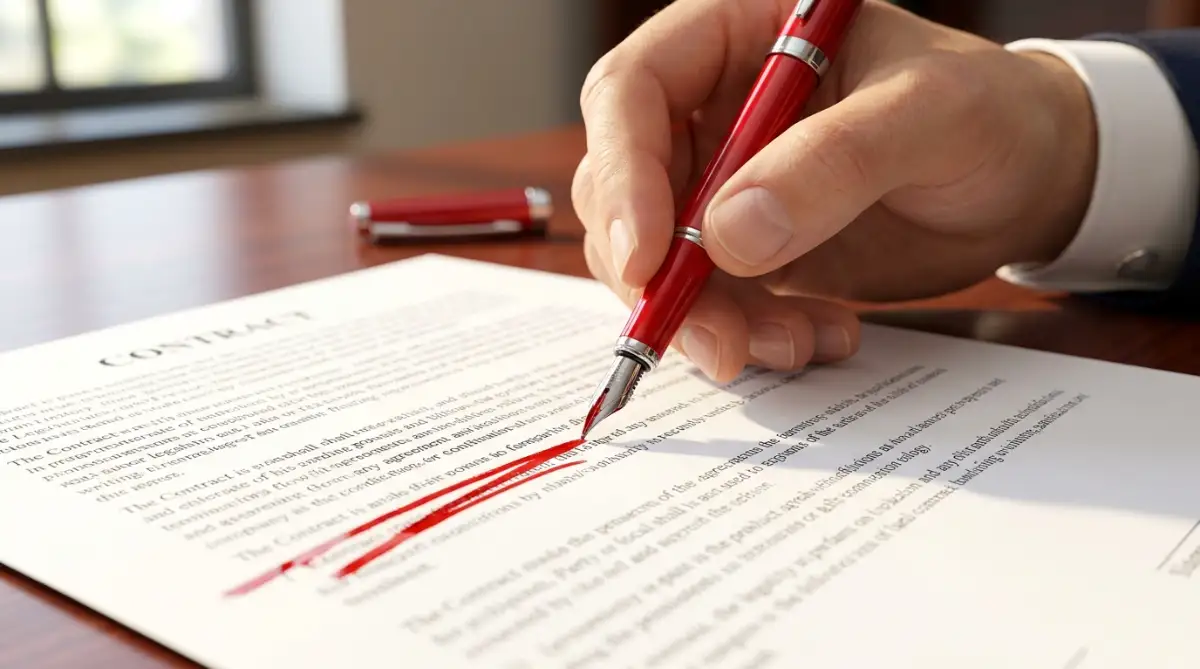
If you see a clause demanding that you pay all legal fees in a dispute, your representative will redline it. They will change it to say that each side pays their own fees. Never be afraid to return a heavily edited document to the sender.
If the other party gets angry that you made changes, that is a massive warning sign. An honest business partner expects you to negotiate.
My Personal Copy-Paste Script for Sending Back Edits
If you feel nervous about sending a redlined document back to a client, you can use the exact email script I use:
"Hi [Name], I am so excited to get started on this project! I had my representative review the paperwork, and I have attached a few minor adjustments to the terms so that both of our teams are equally protected. Let me know if you have any questions about these changes, and I will get the final version signed right away."
Define the Exact Scope of Work
One of the biggest financial traps in any service agreement is a poorly defined scope of work. When the boundaries of a project are vague, the other party will constantly ask you to do extra work for free.
Think of this like building a house. If the blueprint just says "build a nice house," the buyer might suddenly demand a swimming pool and a third garage. Because the rules were vague, you end up paying for the extra materials.
Your contract must specifically list exactly what you will do, and more importantly, what you will not do. If they want extra revisions or additional hours, the agreement must state how much extra they will pay for that time.
Allowing a vague scope of work is a quiet path to financial ruin. It is very similar to why paying the minimum credit card balance is a dangerous trap. In both situations, you are working incredibly hard but secretly losing money every single month.
Real-Life Scenario: The Termination Trap
Let us look at a very common scenario that ruins independent contractors and small businesses. You sign a one-year agreement to provide weekly consulting services for a large marketing firm.
You feel secure, so you turn down other job offers to focus on this big client. Three weeks later, they send you an email saying your services are no longer needed, effective immediately.
You look at the contract and discover a "Termination for Convenience" clause. This allows them to cancel the deal at any time, for any reason, without paying you the rest of the money.
A proper representative would never let you sign this without adding a safety net. They would negotiate a "kill fee" or demand a strict thirty-day notice period. You must always secure a safe exit strategy before you commit your time and resources.
For a deeper look into how professionals balance these specific power dynamics, the Harvard Law School Program on Negotiation provides excellent frameworks for business agreements. Understanding these advanced tactics keeps you from being bullied by larger corporations.
Expert Q&A: Navigating Tough Conversations
Question: What if the other company says their legal department strictly forbids any changes to the text?
Answer: This is a very common bluff. Salesmen say this to pressure you into signing quickly. Your representative will politely bypass the salesman and speak directly to their legal team. Lawyers negotiate with other lawyers every single day. The text is almost always flexible.
Question: Does an email confirming a change override the printed document?
Answer: Absolutely not. If a manager promises you something in an email, but the printed agreement says the exact opposite, the printed agreement wins. You must demand that the actual document is updated before your pen touches the paper.
Question: Are non-compete clauses actually enforced by judges?
Answer: This depends heavily on where you live, as state laws change rapidly. However, fighting a non-compete in court will easily cost you thousands of dollars in legal fees. It is always safer to strike it from the document entirely rather than hoping a judge will save you later.

The Silent Saboteurs: Behaviors That Destroy Your Leverage
Even when people hire a professional to review their paperwork, they often accidentally sabotage their own protection. Human emotions and the desire to be polite frequently override common sense.
The courtroom does not care about how friendly the other manager was during lunch. The legal system operates on cold, hard facts written on paper.
If you want to protect your assets and your mental peace, you have to stop falling for these common emotional traps. Your behavior during the negotiation is just as important as the document itself.
Trusting the Handshake Promise
This is the single most common mistake made in business today. You point out a terrifying penalty clause to your new business partner, and they wave their hand dismissively. They smile and say, "Oh, do not worry about that line. We just use this old template for everyone. We would never actually enforce that penalty against you!" Because you want the deal to move forward, you smile back, trust their word, and sign it. You just made a fatal mistake.
In the legal world, there is a strict rule preventing outside conversations from changing a written deal. The Legal Information Institute at Cornell Law School explains the Parol Evidence Rule, which generally states that a judge will not listen to what was spoken if the written document contradicts it.
If their company is sold to a new owner next year, that new owner will absolutely enforce the penalty. They do not care about the friendly handshake you had with the previous manager. If it is not written in the final draft, it simply does not exist.
Ignoring the "Venue and Jurisdiction" Clause
Many people read the financial terms carefully but completely ignore the boring paragraphs at the very end. This section often contains a "Governing Law and Venue" clause. This sneaky paragraph dictates exactly where a lawsuit must take place if things go wrong. Let us say you live and run your small business in Texas.
You sign an agreement with a software vendor based in New York. If their venue clause says all disputes must be handled in Manhattan, you are in massive trouble.
If they breach the agreement, you now have to buy plane tickets, book hotels, and hire a New York-based attorney just to defend yourself. The massive travel and legal costs often force people to drop their cases entirely.
Never agree to fight a battle on someone else's home turf. Always demand that the jurisdiction remains in your own home state.
Rushing the Review Process
Desperation is the enemy of a good business deal. When you need money or want a project badly, you tend to speed up the process to get the check faster. The other side will often use fake deadlines to increase your anxiety. They will tell you that the offer expires at midnight to prevent you from showing the paperwork to an expert.
Rushing through a legal review is incredibly dangerous. It is similar to ignoring careful research when figuring out how to design a balanced crypto portfolio from scratch. If you throw your money into a project without studying the foundation, you are basically gambling.
Take a deep breath and slow the entire process down. A real, profitable business opportunity will still be there on Monday morning after your representative has time to read it properly.
Your Contract Survival Action Plan
We have covered some heavy and frightening truths today. However, this knowledge should not make you fear doing business. It should make you feel incredibly empowered.
You are no longer wandering in the dark. You know exactly how the traps are set, and you know exactly how to disarm them.
You have the power to draw a hard line in the sand. Your signature is highly valuable, and nobody gets it until the terms are fair.
Steps to Protect Yourself Moving Forward
You do not need to be a millionaire to afford basic legal protection. Many attorneys offer flat-fee contract reviews that cost less than a nice dinner. There are also reputable subscription services that provide document review for small business owners.
Before you sign anything, build a habit of pausing. Read every single page, even the boring ones at the very end.
If you see a word you do not understand, pull out a highlighter and mark it. Never pretend to understand a confusing paragraph just to look smart. Ask direct questions and demand clear, written answers.
A Final Note on Professional Boundaries
Protecting your business requires a lot of patience and strict boundaries. Much like using a parent's guide to understanding early childhood learning styles to gently but firmly guide a child, you must gently but firmly guide your business partners.
You train people on how to treat you. When you demand a fair, balanced agreement, you immediately command respect.
The next time a thick stack of papers slides across the table, you will not feel panic. You will simply smile, put your pen away, and say, "I look forward to reviewing this with my representative." That single sentence is your ultimate shield against the hidden dangers of the corporate world.
Legal & Financial Disclaimer: The information provided in this article is for educational and informational purposes only and does not constitute professional legal advice. The legal concepts discussed here may vary greatly depending on your specific state, country, or jurisdiction. We are not attorneys, and reading this blog does not create an attorney-client relationship. Before signing any legally binding document, business agreement, or contract, you should always seek direct counsel from a licensed attorney in your area to ensure your specific rights and assets are fully protected.