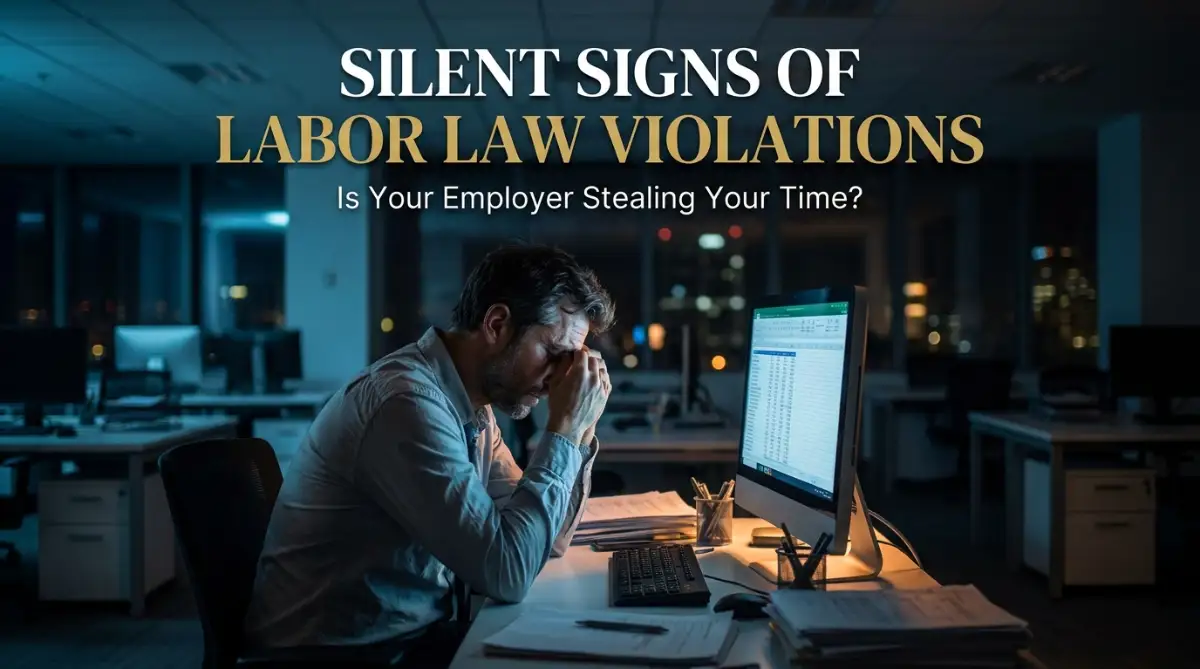
The Hidden Nightmare of Wage Theft
Have you ever clocked out for the day, only to have your boss hand you "just one quick task" on your way out the door? We usually smile, do the extra work, and think we are just being good team players. But here is the hard truth: those tiny favors are actually a highly calculated form of corporate theft. Let me show you how companies quietly steal your paycheck and exactly how you can fight back today.
I told myself that this was just a normal part of holding a professional job. I genuinely believed that sacrificing my personal time would eventually lead to a big promotion or a massive raise.
Instead, that one quick spreadsheet turned into regular weekend emails, mandatory lunch meetings, and hours of unpaid work every single week. I was losing sleep, my relationships were falling apart, and I was constantly stressed about my job.
When I finally realized what was actually happening to me, the anger hit me like a ton of bricks. My employer was not testing my loyalty; they were quietly and systematically stealing my wages.
They ask you to answer a few emails from bed, or they tell you to clock out before finishing your closing duties. Because you need the paycheck, you stay quiet and just accept the extra burden.
This silent abuse destroys your mental peace. You go home feeling completely drained, constantly worrying about work tasks while trying to play with your kids.
The financial stress is even worse because you are giving away hours of your life entirely for free. Families end up struggling to pay rent while their employers quietly pocket the money they rightfully earned.
When you do not know your basic legal rights, bad managers will easily take advantage of your strong work ethic. It is time to pull back the curtain and look at the exact tricks companies use to bypass federal rules.
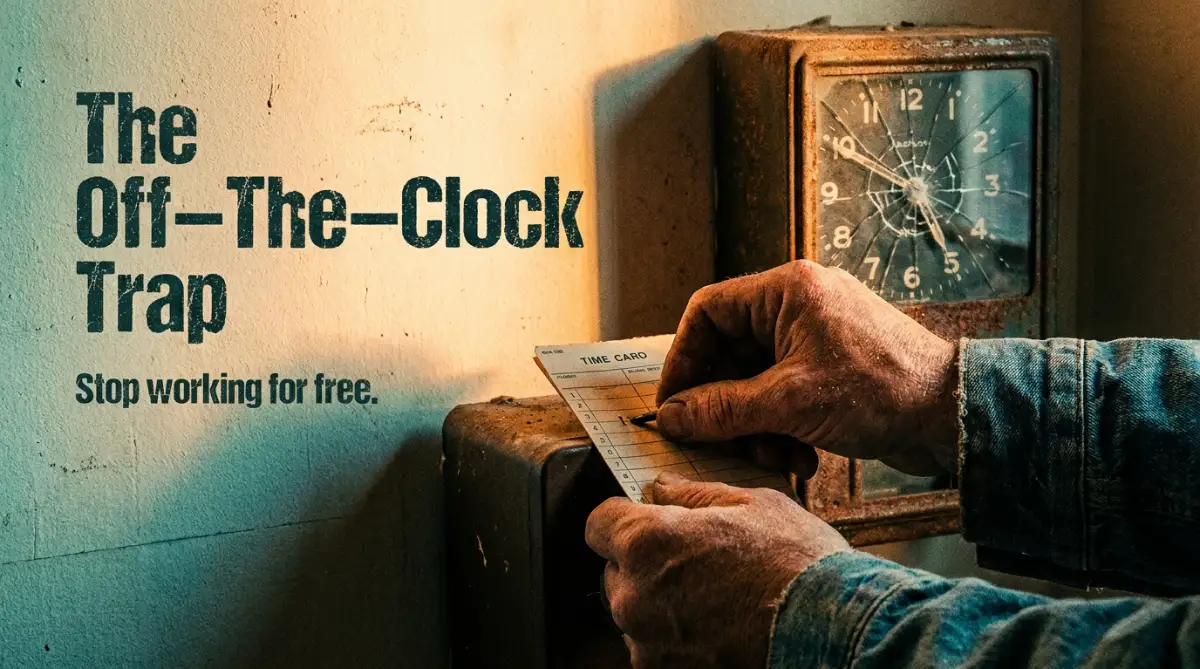
Your Action Plan: Stop Working for Free Today
- Track your own hours down to the exact minute using a personal notebook or tracking app.
- Understand that a fancy "manager" title does not automatically cancel your overtime pay.
- Always force your boss to put their weird, off-the-clock requests in an email.
- Never use your work computer or company Wi-Fi to research your labor rights.
Decoding the Tricks: How Companies Steal Your Time
We are often taught that a good employee never complains and always goes the extra mile. While having a strong work ethic is great, companies heavily exploit this mindset to boost their own profits.
The legal system surrounding employment is incredibly strict, but managers know that most people will never read the actual rulebook. They rely entirely on your confusion and your fear of getting fired.
When you learn to spot these specific management tricks, everything changes. Let's break down the most common traps people fall into when dealing with shady employers.
The Illusion of the "Salary" Promotion
One of the oldest tricks in the corporate playbook is giving someone a fancy job title to avoid paying them extra money. You might be working the cash register for a year, and suddenly, your boss promotes you to "Assistant Shift Manager."
They put you on a fixed salary and tell you that you no longer qualify for overtime pay. You feel proud of the promotion, so you start working fifty or sixty hours a week without questioning your paycheck.
This is a massive legal misconception that cheats workers out of millions of dollars every single month. Simply putting you on a salary does absolutely nothing to remove your right to overtime pay.
Under federal rules, your actual daily duties determine if you get overtime, not your made-up job title. If you are still ringing up customers, stocking shelves, or doing manual labor for most of your shift, you likely still deserve time-and-a-half pay.
Employers love this trick because a fake management title makes you feel important while saving them a fortune. They get a highly dedicated worker who will stay late every night entirely for free.
I actually lost hundreds of dollars at my first real job because I thought being a "coordinator" automatically meant I had to work late for free. My pro tip? Never assume a salary means you are legally exempt from overtime; always compare your daily physical tasks against the federal guidelines to see what you actually deserve.
Quick Check: Are You Really Exempt From Overtime?
| Your Situation | What Your Boss Says | The Legal Reality |
| :--- | :--- | :--- |
| You manage 0 people but have a "Manager" title | "You are salaried now!" | You still get overtime. Fake titles mean nothing. |
| You do the exact same manual labor as your team | "Managers don't get overtime." | If your primary duty is physical labor, you get paid extra. |
If you are totally confused about how overtime exemptions actually work, you are definitely not alone. Watch this amazing breakdown explaining exactly how companies use the salary label to steal your wages legally.
The "Off-the-Clock" Hustle
Have you ever arrived at work and your boss asked you to quickly wipe down the counters before you officially punch in? Or maybe you clocked out for the day, but a customer walked in, so you stayed to help them out.
Managers love to call these moments "small favors" or just part of being a team player. In reality, working off the clock is a massive violation of federal employment laws.
If you are performing any task that benefits the company, you must be paid for that exact time. It does not matter if the task only takes five minutes.
Those little five-minute favors add up to hours of stolen wages by the end of the year. Think about it like a grocery store; you would never walk out with a loaf of bread without paying, so why should your boss take your labor for free?
Many companies will even set their timekeeping software to automatically round your hours in their favor. If you clock in at 8:53 AM, the system might push your start time to 9:00 AM, stealing seven minutes of your pay.
You must keep your own personal record of exactly when you start working and when you stop. A simple notebook in your car or a note on your phone is your best defense against timecard fraud.
Myth vs. Reality: The "Volunteer" Trap
- The Corporate Myth: "You can totally stay late and volunteer your time if you want to help the team catch up."
- The Legal Reality: Federal law strictly bans you from volunteering for your own for-profit employer. If you do the work, they legally have to pay you. Period.
The Myth of the "Mandatory" Unpaid Meeting
Corporate culture is completely obsessed with meetings, training sessions, and team-building exercises. Your employer might schedule a mandatory staff meeting on a Saturday morning and tell everyone it is unpaid because no actual work is being done.
They might claim it is just an "informational session" to help the team bond. This is a very common lie used to avoid paying people for their required attendance.
If your boss requires you to be somewhere, they legally have to pay you to be there. It really is that simple.
If you cannot choose to stay home without facing a penalty, then you are officially on the clock. Even if you are just sitting in a chair watching a training video, you are giving up your personal time for the company's benefit.
Do not let them buy you pizza and call it a fair trade for your Saturday morning. Always demand your normal hourly rate for any mandatory event outside of your regular schedule.
The Independent Contractor Disguise
The rise of gig work and freelance jobs has given employers a brand new way to dodge their legal responsibilities. Many companies will hire you, tell you exactly what hours to work, and provide all your tools, but they will classify you as an "Independent Contractor."
They will hand you a 1099 tax form at the end of the year instead of a standard W-2. They do this because independent contractors do not get overtime pay, health insurance, or unemployment benefits.
The company basically gets all the benefits of having a full-time employee without paying any of the required taxes or benefits. This is called worker misclassification, and it is highly illegal.
If your boss tells you exactly how to do your job, when to show up, and provides the equipment, you are almost certainly a regular employee. True independent contractors run their own business, set their own hours, and use their own tools.
When a company misclassifies you, they are forcing you to pay their share of the employment taxes. You end up with a massive tax bill in April because your employer decided to play games with your paperwork.
The "Deduction" Deception
Working in retail or the restaurant industry comes with a lot of specific financial risks. Sometimes a cash register comes up short at the end of the night, or a customer decides to dine and dash without paying their bill.
A toxic manager will often pull you into the back room and demand that you cover the missing money out of your own pocket. They might threaten to fire you if you do not pay for the broken plates or the stolen merchandise.
Federal laws are very clear about this situation. An employer generally cannot deduct money from your paycheck for cash shortages or broken items if it drops your pay below the minimum wage.
Even if you are making more than minimum wage, many states completely forbid these types of deductions entirely. The company owns the business, which means they own the risk of doing business.

You are simply an employee trading your time for an hourly wage. You are never responsible for covering the company's financial losses just because a mistake happened during your shift.
The Trap of the Unpaid Working Lunch
We all know the feeling of having too much work and not enough time to finish it. You might decide to sit at your desk, eat a sandwich with one hand, and answer emails with the other hand.
Your manager sees you doing this, smiles, and walks away without saying a word. When your paycheck arrives, you notice they automatically deducted thirty minutes for a lunch break you never actually took.
Companies often use automated systems that deduct lunch breaks whether you took them or not. If you are eating while working, you are still legally on the clock.
A true unpaid lunch break requires you to be completely relieved of all your professional duties. If you have to answer the phone, watch a machine, or monitor an inbox, you are working.
If your boss knows you are working through lunch and does not stop you, they legally owe you that money. Do not let a computer system automatically steal your wages just because you were trying to be productive.
The Retaliation Reality
Perhaps you already know your rights, and you finally gathered the courage to ask your boss about your missing overtime pay. A good employer will immediately apologize, fix the error, and cut you a check.
A bad employer will smile, tell you they will look into it, and then slowly start making your life absolutely miserable. This is called workplace retaliation, and it is the silent killer of employee morale.
Suddenly, your perfect work schedule gets changed to the worst possible shifts. You stop getting invited to important meetings, and your manager starts giving you terrible performance reviews for tiny mistakes they used to ignore.
They do not fire you right away because that would look too suspicious. Instead, they try to make you so incredibly unhappy that you just quit on your own.
Retaliation is completely illegal, but it is often very hard to prove. This is why you must document everything in writing.
If you ask about your pay, do it through an email so there is a digital paper trail. Write down the dates, times, and exact details of how your manager treats you after you bring up a legal concern.
Protecting yourself requires a strong strategy and a deep understanding of the rules they are trying to break. Your time is your most valuable asset, and nobody has the right to take it from you without fair compensation.
Building an Unbreakable Defense Against Wage Theft
Knowing that your employer is taking advantage of you is only half the battle. If you want to actually recover your stolen wages and force the company to change its behavior, you need undeniable proof.
Managers who break federal rules are usually incredibly smart about hiding their tracks. They will rarely put illegal instructions in writing, and they rely heavily on verbal commands to keep their hands clean.
If you decide to file a wage claim or talk to a lawyer, your personal memory of working late will not be enough to win. You must start building a rock-solid wall of evidence while you are still working at the company.
I want to share the exact strategies legal experts recommend for documenting shady workplace behavior. These daily habits will completely protect your rights without raising any immediate suspicion from your boss.
The Power of the Personal Shadow Logbook
You can never blindly trust your employer’s official timekeeping software. Many modern corporate systems are actually programmed to round down your hours or automatically deduct unpaid lunch breaks, even when you work straight through them.
You need to create your own personal shadow log. Every single day, write down the exact minute you start working and the exact minute you stop.
Do not just write "9 to 5." Write down "Logged into computer at 8:54 AM, logged out at 5:12 PM." This tiny level of specific detail becomes incredibly powerful if you ever have to sit in front of a judge.
You can use a simple paper notebook that you keep in your car, or download the official, free Timesheet App provided by the US Department of Labor right on your smartphone. The key is to keep this record entirely on your own personal property, not on a company laptop.
The "Innocent Clarification" Email Strategy
Toxic managers love to give illegal instructions verbally. They will pull you aside in the hallway and casually say, "Hey, make sure you finish cleaning the showroom floor after you clock out tonight."
If you complain later, they will completely deny ever saying it. You can completely destroy this tactic by using the innocent clarification email.
When a boss tells you to work off the clock, simply say "No problem." The moment you get back to your desk, send them a quick email from your work account.
You write something like, "Hi Sarah, I just want to make sure I understood you correctly in the hallway. You want me to clock out at 6:00 PM, and then stay afterward to mop the showroom floor, right?"
This forces them into a corner. If they reply "Yes," you now have a written confession of a federal labor violation. If they realize their mistake and say "No, do it on the clock," you just saved yourself from working for free.

Just like why signing a business contract alone is a terrible idea without a paper trail, doing extra work based on verbal promises is a massive risk. Always force your managers to put their weird requests in writing.
Decoding the Invisible Math on Your Pay Stub
Most people rip open their paycheck, look directly at the final dollar amount, and throw the paper in the trash. This is exactly what shady payroll departments hope you will do.
You need to sit down at your kitchen table with a calculator and check their math every single pay period. Look specifically at your overtime rate.
According to the fair labor standards explained by the Legal Information Institute at Cornell Law School, any hours worked over forty in a single workweek must be paid at one and a half times your regular hourly rate.
Some deceptive companies will try to average your hours over two weeks. They might have you work fifty hours one week and thirty hours the next, paying you straight time for all eighty hours.
That is highly illegal. Overtime is calculated on a strict seven-day workweek, and they absolutely owe you the premium rate for those extra ten hours in week one.
Protecting Your Digital Privacy at Work
If you suspect your employer is doing something illegal, you might feel the urge to start recording your conversations with HR or your manager. You must be extremely careful with this idea.
Many states have strict two-party consent laws, meaning it is a literal crime to record someone without their permission. On top of that, many companies install aggressive tracking software on their office computers.
They can see every email you send, every file you download, and every website you visit. It feels incredibly invasive, almost like leaving your smart speaker microphone turned on in your private living room while strangers listen in.
Never use your work computer to research labor lawyers or file a complaint with the government. Always use your personal smartphone on your own private internet connection to do your legal research.

The Most Dangerous Traps Angry Workers Fall Into
When you finally realize that your employer has been stealing hundreds of dollars from your paycheck, your natural reaction is pure anger. You feel betrayed, used, and completely disrespected.
This intense emotional reaction is totally valid, but it is also the exact thing that will ruin your chances of getting your money back. When people act out of anger, they make massive strategic errors that give the company a perfect excuse to fire them legally.
If you want to hold your company accountable, you have to play a very smart, patient game of chess. You must completely avoid these common, self-destructive mistakes that ruin perfectly good wage claims every single day.
The "Robin Hood" Evidence Grab
When employees decide they want to sue their boss, they often panic and try to gather as much evidence as possible in one day. They start forwarding sensitive company emails, client lists, and internal financial documents to their personal Gmail account.
They think they are just gathering proof that they were working late. However, to the company's IT department, this looks exactly like corporate espionage or a massive data breach.
The moment the company sees you downloading files to a personal drive, they will instantly fire you for violating their data security policy. Instead of fighting a simple wage claim, you are now being sued by a massive corporation for stealing trade secrets.
You might think you are protecting yourself, but stealing company data is just as dangerous as falling for fake remote jobs that steal your identity. Only keep personal records of your own hours, and let a lawyer request the official company documents legally through the court system.
Believing Human Resources is Your Personal Friend
This is a very bitter pill for many dedicated employees to swallow. The Human Resources department does not exist to protect you from the company; it exists to protect the company from you.
The friendly HR manager who brings donuts on Fridays is ultimately paid by the same CEO who is stealing your overtime. If you walk into their office and aggressively yell, "My boss is breaking federal labor laws!" they will immediately go into defense mode.
They will start building a secret file on you, looking for any tiny mistake you make to justify firing you for "poor performance." If you need to talk to HR about your paycheck, keep all of your emotions out of the room.
Simply send a polite, boring email saying, "I noticed a discrepancy on my last pay stub regarding my total hours. Could we please review my timecard together?" If you want to understand how to properly report a serious violation outside of the company, check out the incredible worker resources provided by Workplace Fairness, a trusted non-profit organization.
The Social Media Meltdown
We live in a culture where people love to vent about their bad days on the internet. If your manager forces you to work through lunch again, it is incredibly tempting to post an angry rant on Facebook or TikTok about how terrible your company is.
This is the absolute fastest way to destroy your own credibility. Defense lawyers for the company will instantly screenshot all of your social media posts.
They will present your angry rants to a judge and argue that you are just a bitter, toxic employee looking for revenge. They will completely distract everyone from the actual stolen wages and focus entirely on your online behavior.
Keep your workplace disputes completely off the internet. Do not post passive-aggressive quotes, do not name your manager, and do not discuss your paycheck with anyone except your family and your legal representation.
Waiting Until the Clock Runs Out
Many workers are completely terrified of losing their jobs, so they stay quiet about wage theft for years. They tell themselves they will finally report the company after they find a new job somewhere else.
The legal system does not wait forever for you to make up your mind. Under federal rules, there is a strict statute of limitations for recovering stolen wages, which is usually only two or three years.
If you wait four years to report that you were forced to work off the clock, that money is gone forever. You simply cannot afford to stop delaying tasks when your hard-earned paycheck is on the line.
You must take action while the evidence is fresh and the timeline is legally valid. Even if you are scared, having a completely free, confidential consultation with an employment lawyer is always the smartest first step.
Quitting in a Blaze of Glory
We have all dreamed about that movie moment where we storm into the boss's office, slam our badge on the desk, and tell them exactly what we think of them before walking out the door. While it feels amazing in your head, quitting dramatically is a terrible financial decision.
When you voluntarily quit your job, you instantly lose your right to collect unemployment benefits in most states. You are suddenly left with zero income while you try to fight a massive corporation in court.
If the working conditions are absolutely unbearable, employment experts at the National Employment Law Project often recommend exploring a concept called "constructive discharge." This means the company made things so legally toxic that you were essentially forced to leave.
However, you should never walk away from a job without speaking to a professional first. Always plan your exit quietly, secure your personal finances, and let your attorney do the yelling for you.
Your Personal Blueprint for Reclaiming Your Time
They rely entirely on the hope that you are too tired, too confused, or too scared to ever read the federal rulebook. But you are no longer in the dark.
You now understand the difference between a real salary and a fake title. You know that mandatory weekend meetings are never free, and you know exactly how to document illegal requests without putting a target on your own back.
Your physical energy and your time on this earth belong strictly to you. When you clock out, you deserve to go home, rest, and completely disconnect from the stress of the workplace.
I remember the exact morning I finally decided I had enough of working through my lunch breaks for a manager who did not respect me. My hands were literally shaking when I sent that first email asking for my rightful overtime pay, but the moment I hit send, I got my self-respect back. You deserve to be paid for every single minute of your hard work, so grab a notebook, start tracking your hours tomorrow morning, and never let anyone steal your time again.
Common Questions About Federal Labor Laws
Can my boss legally fire me for asking about unpaid overtime?
Absolutely not. Firing, demoting, or punishing an employee for asking about their rightful wages is considered illegal workplace retaliation. If they fire you shortly after you ask for your overtime pay in writing, you have incredibly strong grounds for a wrongful termination lawsuit.
Does getting paid a fixed salary mean I never get overtime?
This is the biggest myth in the corporate world. Getting a salary does not automatically remove your right to overtime pay; your daily physical duties must also fit very specific federal exemptions. If you are on a salary but still spend most of your day doing manual labor or routine tasks, you are likely still legally entitled to overtime.
How far back can I claim stolen wages from my company?
Under the federal Fair Labor Standards Act, you can generally claim unpaid wages going back two years from the date you file your official complaint. If you can prove the employer intentionally and willfully violated the law, that timeline can sometimes be extended to three years.
What if I voluntarily agreed to work off the clock to help the team?
You cannot legally volunteer your time to a for-profit employer for the same job you are paid to do. Even if you happily agreed to clean the shop for free after your shift, federal law states that the company must pay you for that labor to prevent widespread worker exploitation.
Can my manager force me to pay for a broken register or a dine-and-dash?
In most situations, federal law prohibits employers from deducting the cost of broken items or stolen cash from your paycheck if it drops your earnings below the minimum wage. Furthermore, many individual states have even stricter rules that make these types of deductions completely illegal regardless of how much money you make.
Disclaimer: This article is strictly for educational and informational purposes only and does not constitute official legal, financial, or professional advice. Labor laws vary significantly by state and local jurisdiction, and every employment situation is unique. Always consult a licensed employment attorney or your state's Department of Labor to fully understand your legal rights before taking any action against an employer.