
Fast Facts: Why DIY Legal Papers Fail
- Missing just one state-specific rule (like the wrong type of witness signature) instantly ruins the entire paper.
- Your online bank and retirement beneficiary forms will completely override whatever you write on a physical piece of paper.
- Leaving cash directly to young children forces the court to step in, draining the funds through heavy administrative fees.
- Hiding secret debts from an advisor leaves a hidden financial bomb for your grieving kids to clean up.
The Heartbreaking Reality of a Badly Written Will
Imagine spending your entire life building a safe home for your family, only to have a judge hand it over to the state because of a missing signature. That is exactly what happens thousands of times a year when people try to play attorney with cheap online templates. You think you are saving a few hundred bucks by doing it yourself, but you might actually be setting your kids up for a complete financial nightmare. Let me show you exactly why that single piece of paper can destroy everything you worked so hard to protect.
My friend's father had been a hardworking, honest man all his life. He loved his children deeply and wanted to make sure they were taken care of after he passed away.
But to save a few hundred dollars, he decided to write his final wishes himself using a cheap online template. He thought he was doing the smart thing, keeping things simple and avoiding expensive hourly rates.
That single decision turned out to be the most expensive mistake he ever made. Because he did not understand the specific rules of his state, his document was missing one required signature.
Just one signature. But in the eyes of the law, that tiny oversight meant the entire document was completely invalid. The court threw it out, and the state took control of everything he owned.
Suddenly, his grieving children were forced to hire expensive litigators just to claim their childhood home. I watched them drain their savings, point fingers at each other, and slowly destroy their relationships.
The emotional toll was heavy, and the mental peace they should have had while mourning was entirely shattered. They spent sleepless nights wondering how a simple DIY project turned into a never-ending legal nightmare.
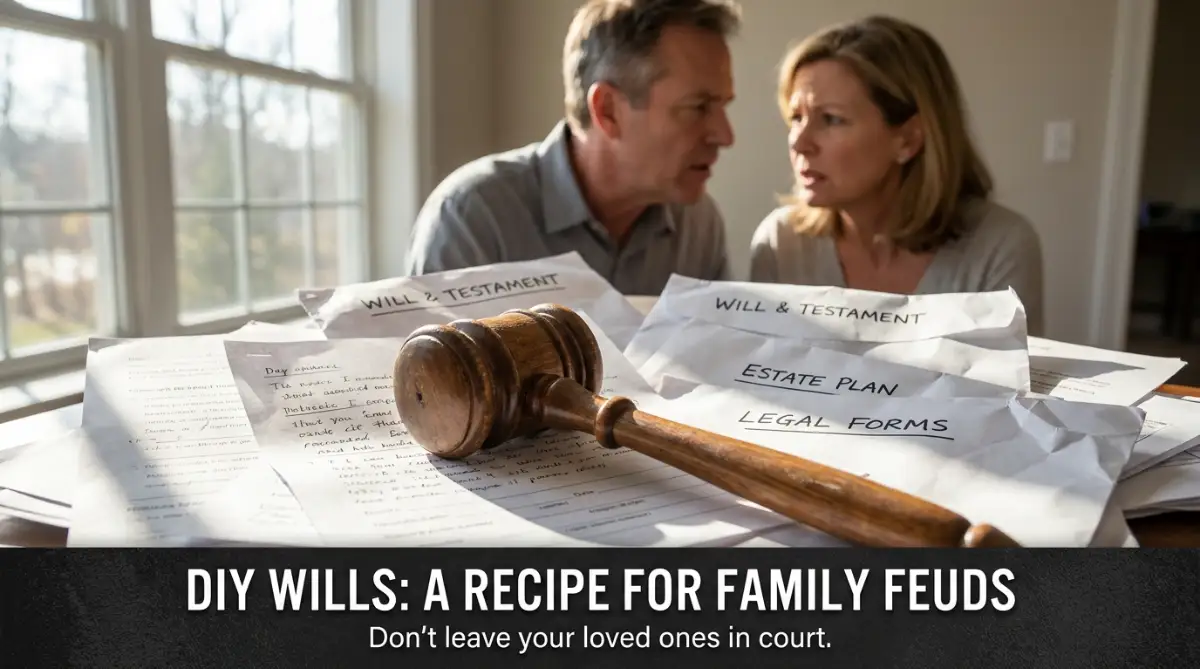
Why the "Simple" DIY Route is a Massive Trap
We live in a world where we can order groceries from our phones and build our own furniture using video tutorials. Because of this, many of us assume that writing down our final wishes should be just as easy.
You just type out who gets the house, who gets the money, print it, and sign it, right? Unfortunately, the legal system does not work like a simple checklist.
Estate laws are incredibly strict, highly specific, and very unforgiving when it comes to errors. When you write your own legal documents without professional guidance, you are walking through a minefield blindfolded.
Let me break down the absolute worst traps people fall into when they try to play attorney for a day.
Trap 1: Failing the Strict Witness and Signature Rules
You might think that your signature is enough to prove that you wrote the document. This is a massive misconception that destroys families every single day.
Almost every jurisdiction requires that you sign your documents in front of at least two adult witnesses. But here is the massive catch that most DIY templates never warn you about.
Those witnesses usually cannot be people who are getting anything in the document. If you leave your car to your nephew, and your nephew signs as a witness to prove you signed it, you have just created a massive legal conflict.
In many places, having an interested party sign as a witness automatically cancels out their inheritance. In some strict states, it invalidates the entire document, sending your assets straight into the state's default distribution rules.
I have seen people use their spouse or their children as witnesses because they were the only ones in the living room at the time. They thought they were just wrapping up paperwork, but they were actually setting their family up for a massive legal battle.
Trap 2: Using Vague and Ambiguous Language
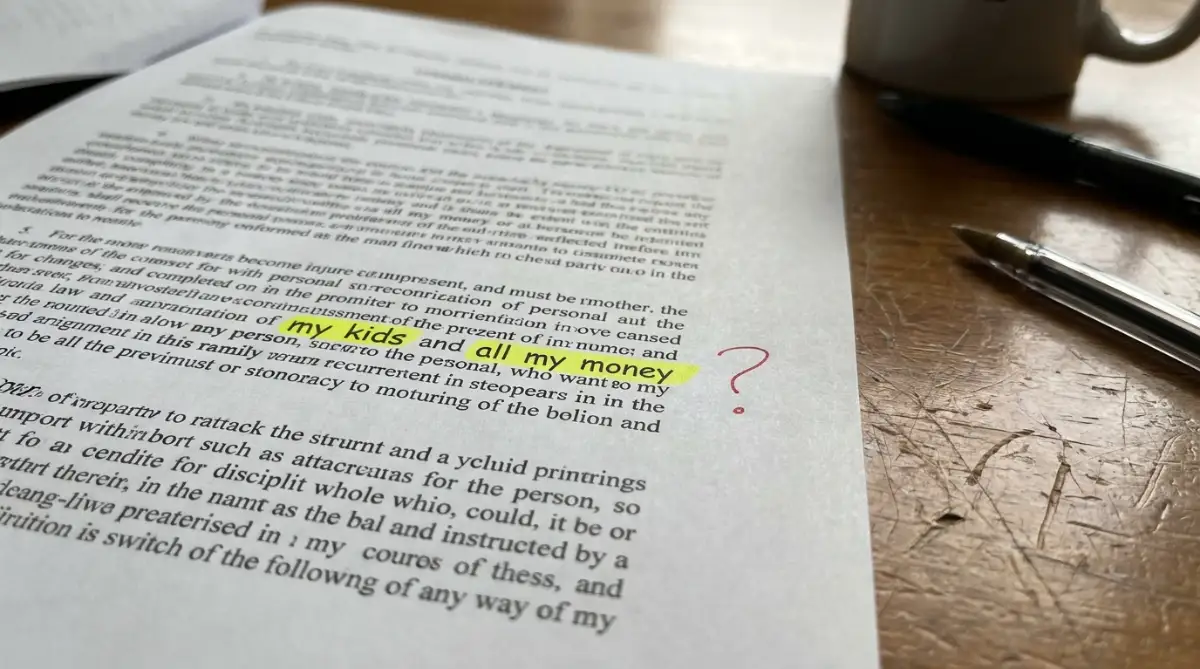
When we talk to our families, we use casual language because they know what we mean. You might say, "I want all my money to go to my kids."
To you, that makes perfect sense. But to a judge reading this on a cold piece of paper, it is incredibly confusing.
Which money? Do you mean your checking account, your retirement fund, or the cash under your mattress? Who exactly are "your kids"?
Does that include your stepchildren whom you raised since they were toddlers? Does it include children born out of wedlock? What if one of your children passes away before you do—does their share go to their kids, or is it divided among your surviving children?
When you use vague words, you force the legal system to guess your intentions. And courts absolutely hate guessing.
When things are unclear, estranged relatives often step in to claim a piece of the pie. They will hire aggressive representation to twist your words and claim you meant something completely different.
To avoid this, identify everything with absolute precision. You need full legal names, clear percentages, and specific asset descriptions.
Before you continue reading, take a moment to watch this eye-opening breakdown of what exactly happens when a will goes wrong.
Trap 3: Forgetting the "Residuary Clause" (The Leftover Rule)
This is perhaps one of the most common and devastating oversights I see in homemade estate planning. People are usually very good at giving away their big-ticket items.
You give the house to your daughter, the vintage car to your brother, and the savings account to your spouse. But what happens to everything else?
What happens to the tax refund that arrives after you pass away? What happens to the small side bank account you opened and forgot about? What about the furniture, the jewelry, or the sudden inheritance you might receive from a distant relative right before you die?
If your document does not include a residuary clause—a safety net that dictates where all the leftover, unmentioned items go—the court steps in.
Any asset not specifically mentioned, and not covered by a residuary clause, is treated as if you died without any instructions at all for that specific item. This means the court has to open a separate process just to figure out who gets your forgotten assets.
It slows down the distribution of your main assets, costs your family extra legal fees, and causes unnecessary headaches.
A Quick Reality Check: The Executor Trap
I remember when I first helped a family member look over their rough draft. They had named me as the sole executor to manage their estate. But my immediate realization was: "What if I get into a car accident next week?" I realized right then that naming only one person to handle your estate is a massive risk. You always need a backup person, or even a third backup, because life is entirely unpredictable.
Trap 4: Misunderstanding "Non-Probate" Assets
Here is a shocking truth that surprises almost everyone: your written instructions do not control everything you own.
Certain assets pass entirely outside of your written instructions. These are called non-probate assets.
For example, think about your life insurance policy or your 401(k) retirement account. When you set up those accounts, the company asked you to name a beneficiary.
That beneficiary form overrides whatever you write in your personal documents.
Let's say you named your ex-spouse as the beneficiary of your life insurance policy ten years ago. You get divorced, remarry, and write a brand new document leaving absolutely everything to your new spouse.
When you pass away, who gets the life insurance money? Your ex-spouse gets every single penny.
The insurance company does not care what your newly printed papers say. They only look at the official beneficiary form on their servers.
People who draft their own documents without professional help rarely understand how these different systems interact. They think they have protected their current family, but they accidentally leave massive wealth to people they have not spoken to in years.
Trap 5: The "Set It and Forget It" Mentality
Life changes rapidly, but homemade legal papers usually sit in a drawer collecting dust. People write their instructions when they get married and then never look at them again.
This creates a massive disconnect between what the paper says and what your actual life looks like.
If you have a new child, get divorced, buy property in another state, or start a business, your old instructions might become completely useless or even harmful.
In some jurisdictions, getting divorced automatically revokes certain parts of your documents. In others, it does not. If you move across the country, the laws of your new home might have completely different requirements for validity.
An attorney does not just write a piece of paper; they help you build a strategy that adapts to your life. When you do it yourself, you miss out on the strategic updates that keep your family safe as your life evolves.
The Illusion of Saving Money
Hiring professional help requires an upfront investment. But you have to look at the big picture and the long-term math.
A DIY template might cost you fifty dollars today. But if it contains a single error, a vague sentence, or a missing signature, the probate court will freeze your assets.
Your family will have to hire litigators to fix your mistakes. Those professionals charge hundreds of dollars per hour.
A mistake that saved you five hundred dollars today could easily cost your grieving children fifty thousand dollars in legal fees later.
How to Protect Your Legacy the Right Way
If you want to ensure your family is truly protected, you need to change how you view this process. It is not just about filling in blanks on a form.
It is about creating a secure, unbreakable wall of protection around the people you love most.
Find a local professional who focuses entirely on estate laws. You do not want a general practitioner who mostly handles traffic tickets. You want someone who breathes and sleeps estate rules in your specific area.
Have an open and honest conversation about your assets. Do not hide things from your professional advisor. They need to know about your secret bank accounts, your strained relationship with a child, or your complex business partnerships.
The more they know, the better they can protect your estate from future attacks.
Review your plan every three to five years. Put a reminder on your calendar. Whenever a major life event happens—a birth, a death, a marriage, or a major purchase—take a quick look at your documents to make sure they still match your wishes.
Real-Life Scenario: The Power of Professional Help
Consider the story of a small business owner named Sarah. She wanted to leave her bakery to her daughter and her savings to her son.
She started filling out a free form online. But halfway through, she realized she had no idea how to transfer business ownership legally upon her passing.
Instead of guessing, she sat down with a local advisor. The advisor discovered that if Sarah had used the online form, her business would have been trapped in court for months, causing it to go bankrupt before her daughter could even take over.
The professional helped her set up a specific trust that allowed the business to transfer immediately, without court interference. Her daughter kept the bakery running smoothly, and her son received his funds without any legal delays.
The Final Reality Check on DIY Planning
Your legacy is the final message you leave to your loved ones. It is your last chance to take care of them, guide them, and provide for their future.
Leaving that immense responsibility to a generic online form is a gamble you cannot afford to take. The stress, the confusion, and the financial ruin that follow a poorly drafted document are completely preventable.
Take the time to do it right. Invest in proper guidance. Give yourself the ultimate peace of mind knowing that when the time comes, your family will be protected, your wishes will be honored, and your legacy will remain entirely secure.
Smart Strategies to Secure Your Legacy Without the Heavy Cost
Let me tell you a secret that many high-priced professionals might not want you to know. You actually do not have to spend ten thousand dollars to get a solid, secure plan in place.
There is a massive middle ground between printing a completely useless free template and paying top-tier corporate rates. You can absolutely protect your family while keeping your budget intact, but you have to be smart about how you approach the process.
The biggest mistake people make is walking into an office completely unprepared. When you sit down with a professional without a clear list of what you own and who you want to give it to, you are paying their hourly rate just to brainstorm.
You can save hundreds of dollars simply by doing the groundwork yourself before you ever schedule a consultation.
Create a highly detailed inventory of your life. Write down every single bank account, investment property, life insurance policy, and physical asset of value.
List out all of your family members, their full legal names, and their current contact information. When you hand this organized file to an advisor, they can immediately start drafting the legal language instead of spending hours extracting basic information from you.
Why You Need to Audit Your Beneficiaries Today
Here is something you can do right now, sitting on your couch, that will save your family immense legal trouble. Go online and check the beneficiary forms on every single one of your financial accounts.
People completely forget that retirement accounts, life insurance, and even standard savings accounts often have transfer-on-death instructions built directly into them. As we discussed earlier, these forms override any separate legal paper you write.
If you want your current spouse to get your retirement fund, you must log into that specific company's portal and make sure their name is clearly listed. You cannot rely on a separate document to override outdated forms sitting on a corporate server.
Many people mistakenly believe that writing a new paper automatically cancels out everything else they have signed in the past. If you want to dive deeper into how legal obligations overlap, you might want to read about why signing a business contract alone is a dangerous trap.
Just like signing a bad business contract without professional eyes can ruin your company, ignoring your account beneficiary forms can completely derail your final wishes.
The Real Cost of Hiding Things from Your Advisor
I made this exact mistake years ago when I first spoke to someone about my own plan. I was too embarrassed to mention a small, outstanding personal loan I had co-signed for a friend. I realized later that by hiding that debt, I was leaving a hidden financial bomb for my family to deal with after I was gone. Always tell your advisor everything, even the ugly financial details.
When you finally sit down with someone who knows the local laws, you have to treat the relationship with absolute honesty. They are not there to judge your financial choices; they are there to protect your loved ones from those choices.
If you have a child who struggles with addiction, you need to say that out loud. If you leave a massive lump sum of cash to someone who cannot handle money, you might actually be funding their destruction rather than helping them.
A professional can help you set up specific rules, like a trust, that distributes the money slowly over time or pays directly for their housing and medical needs. You simply cannot build those safety nets if you hide the reality of your family dynamics.
You also need to disclose all of your digital assets. We live our lives online now, and if your family cannot access your accounts, they could lose everything from digital currencies to irreplaceable family photos.
According to the American Bar Association, properly cataloging digital assets is now one of the most critical steps in modern legacy planning.
Knowing When to Call for a Review
Creating your instructions is not a one-time event; it is an ongoing strategy. The law changes, taxes change, and your life changes.
If you move to a new state, you must have your documents reviewed. The rules for valid signatures and witnesses in Florida are entirely different from the rules in New York.
If you start a new company, get married, or go through a divorce, your plan needs immediate updating. Even if nothing major happens in your life, you should take an hour every three years to read through your paperwork.
Are the people you chose to be your executors still healthy? Are they still willing to take on the responsibility?
If the person you named to handle your estate has moved overseas or become deeply ill, they will not be able to manage the court process for your family. Always keep your choices relevant to your current reality.

The Hidden Landmines That Destroy Family Peace
When people try to save money by doing things themselves, they often trigger legal landmines they never even knew existed. Let's look closely at the specific missteps that turn grieving families into bitter enemies inside a courtroom.
If you want to protect your family's future, you absolutely must avoid these traps at all costs.
Naming a Minor as a Direct Receiver
It sounds incredibly sweet to leave ten thousand dollars directly to your newborn grandchild. But in the eyes of the law, this is a massive administrative nightmare.
Minors are not legally allowed to own significant assets or manage large sums of money. If you leave money directly to a five-year-old, the court will have to step in.
They will appoint a guardian to manage that money until the child turns eighteen. This guardian could be someone you do not approve of, and the court process will slowly drain the inheritance through administrative fees.
Instead of a direct gift, a professional will help you set up a simple custodial account or a trust. This ensures the money is managed exactly how you want, by the person you trust, without the court constantly taking a cut.
Choosing the Wrong Person to Take Charge
People often pick their oldest child to be the executor simply out of tradition. They think, "He is the oldest, so he should be in charge."
But managing an estate requires serious organization, patience, and time. If your oldest child is terribly disorganized, easily angered, or terrible with finances, you are handing them a disaster.
The executor has to file complex tax returns, deal with angry creditors, sell off physical property, and mediate fights between siblings. It is a grueling, thankless job.
If you choose the wrong person, the process will drag on for years, assets will lose value, and your family will resent each other forever. You need to pick someone who is emotionally stable and highly organized, even if that means skipping over your oldest child.
Sometimes, if family dynamics are incredibly toxic, the smartest choice is to hire an independent third-party professional to handle the distribution. It costs money, but it completely removes the emotional burden from your children.
Forgetting About the Tax Man
Many people assume that once they pass away, their debts and tax obligations magically disappear. This is a very dangerous illusion.
Before your children get a single dime of your money, the government and your creditors get to take their share. If you leave your entire savings account to your daughter, but you owe a massive tax debt, the state will seize that account.
You have to plan for these final expenses. If you do not have enough cash to cover your debts, the court might force your family to sell the family home just to pay off what you owe.
When you work with a professional, they look at your entire financial picture. They can help you structure your life insurance or set aside specific funds so your family is not blindsided by a massive bill while they are trying to plan a funeral.

Speaking of unexpected financial disasters, if you run a business, you might want to look into why small businesses fail due to commercial lease mistakes. Ignoring legal details, whether in business or personal planning, always ends in disaster.
Trying to Command People from the Grave
Sometimes, people try to use their final instructions to manipulate the behavior of their living relatives. I have seen documents that say, "My son only gets the money if he divorces his wife," or "My daughter gets the house only if she graduates from medical school."
These are called conditional gifts, and they are incredibly difficult to enforce legally. In many jurisdictions, courts will simply throw out conditions that they consider against public policy, such as forcing someone to get a divorce.
Even if the condition is legal, who is going to enforce it? Your executor will have to spend years monitoring your children's lives, trying to figure out if they met your impossible standards.
This creates massive resentment. Your final message to your family should not be a test or a threat. It should be a clear, clean transfer of your legacy that allows them to move forward in peace.
Hiding the Original Documents
You can hire the best professional in the world, draft a perfect, ironclad plan, and have it legally witnessed. But if nobody can find the original physical paper when you die, the court will treat you as if you never wrote it at all.
I have seen families tear apart houses, break open locked safes, and call dozens of local offices trying to find the original signed document. A photocopy is usually not accepted by a judge, because it is too easy to alter.
Do not hide your documents in a secret floorboard. Tell your executor exactly where the original papers are stored.
If they are in a safe deposit box, make sure your executor actually has legal access to that box. Otherwise, they will have to get a special court order just to open the box to find the instructions they need.
A Clear Path Forward for Your Family
When you look closely at all the strict rules, confusing laws, and hidden traps, it becomes very clear why doing this alone is a terrible idea. The legal system was not built to be friendly to handwritten notes and printed templates.
It was built on rigid rules that demand absolute precision. When you try to save a little money upfront, you are simply passing a massive, expensive problem onto the people you care about most.
Theen you invest in professional guidance, you are buying a shield that protects your loved ones from greedy relatives, angry creditors, and a slow, painful court process. You are giving them the space they need to grieve without forcing them into a legal warroom.
When I finally sat down with a professional to finalize my own plan, the relief I felt walking out of that office was indescribable. I knew that no matter what happened to me tomorrow, my family would not have to fight in a courtroom to survive. Do not wait for a perfect moment to get this done. Pick up the phone tomorrow, find a trusted local professional, and take the final step to truly secure your legacy.
Questions People Frequently Ask About DIY Legal Planning
Is a handwritten note ever considered legally valid?
In a few specific places, a completely handwritten document, known as a holographic will, might be accepted by a judge. However, the rules are incredibly strict, and even one typed word can invalidate the whole thing. It is incredibly risky and almost always leads to family fights in court.
What exactly happens if the court throws out my DIY document?
If your document is ruled invalid, you die "intestate," meaning you die without instructions. The state will then use its own default laws to decide who gets your assets, completely ignoring what you actually wanted.
Can I just use an online service that has a lawyer review the template?
Those hybrid services are better than nothing, but they still have major flaws. The remote reviewer usually just checks for obvious spelling errors, but they do not know your family dynamics or your specific local state laws, leaving you vulnerable to hidden loopholes.
Do I really need professional help if I do not have a lot of money?
Yes, because smaller estates can actually be hurt the most by legal errors. If you only leave behind a modest family home, an expensive court battle caused by a bad template can completely wipe out its value, leaving your kids with nothing.
How often should I check or update my final instructions?
A good rule of thumb is to review everything every three to five years. You must also update it immediately if you get married, divorced, have a new child, or experience a major shift in your financial situation.
Disclaimer: This article is for informational and educational purposes only and does not constitute official legal or financial advice. Laws regarding estate planning and probate vary significantly by state and jurisdiction. Always consult with a licensed, qualified attorney in your specific area before making any decisions regarding your assets or family planning.